

CU Denver Students Innovate Solutions for Real World Problems: Phishing Scams, Remote Rescues and More
Engineering Capstone Showcase to Feature more than 50 Prototypes
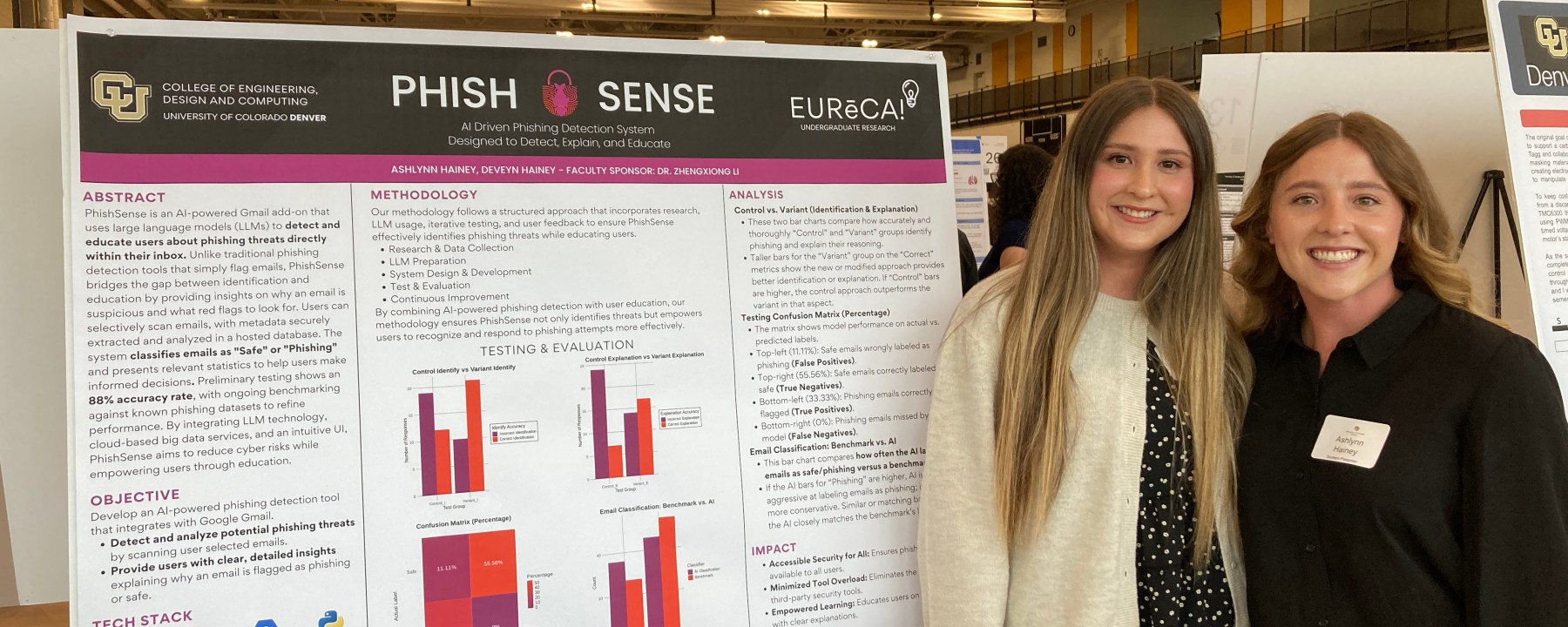
Twin sisters Deveyn Hainey and Ashlynn Hainey developed a phishing detector add-on for Gmail accounts that not only flags scam emails but also educates you on how to distinguish them from legitimate emails.
Caleb Demarest and four of his classmates built a flexible, reconfigurable liquid antenna that can tune across a range of frequencies between 2 GHz and 3 GHz — approximately the same range used by everyday Wi-Fi and cellphone networks. Their prototype uses Galinstan, a safe, highly conductive liquid metal, along with a fluid control system that changes the antenna’s shape to adjust its performance in real time. This technology could lead to smaller, smarter communication systems for satellites, drones, and self-driving vehicles, where saving space and adapting to changing signals is critical.
Garrett Hoiness and three of his teammates focused on creating an app that you can use on your phone when you go hiking in the wilderness with no cell phone towers in sight. If you get lost, you won’t need a cell tower to get help—simply tap the app and let first responders know where to find you.
These are just some of the brilliant innovations CU Denver students will demonstrate at the College of Engineering, Computing and Design Capstone Design Showcase on May 9 on the Auraria Campus.
More than 50 teams—with more than 200 students—are scheduled to present. The Capstone experience is a culmination of everything students have learned throughout the program. It allows them to apply theoretical knowledge to real-world problems, build something tangible, and develop the practical, collaborative, and communication skills that are essential in industry and research.
“Our goal is to empower students to take ownership of their work while ensuring they are well-supported through mentorship, technical guidance, and constructive feedback throughout the entire project lifecycle,” said Computer Science and Engineering Assistant Professor Zhengxiong Li, who mentored Deveyn and Ashlynn. More than 100 faculty are involved in Capstone either supporting student teams or judging their final projects.
Meet some of our innovators.
Phish Sense
Team: Ashlynn Hainey and Deveyn Hainey
Instructor: Zhengxiong Li
Ashlynn and Deveyn wanted to collaborate on a project that combined their individual areas of interest and expertise. Ashlynn has specialized in cyber security while Deveyn’s passion lies in machine learning.
“When we asked ourselves, ‘What’s an issue many people face but have limited support in?’ the topic of phishing emails stood out,” said Deveyn Hainey, a computer science major. “Although there are several tools out there to detect phishing attempts, relatively few focus on educating users. We wanted to create something that not only identifies threats but also helps people understand the why behind them so they can learn how to spot threats independently in the future.”
The project was tough, but they were motivated by the potential impact. Their software could go a long way toward addressing a national problem that, according to the FBI, cost Americans more than $16 million in 2024.
“The most difficult aspect of this project was navigating the Gmail add-on platform, Ashlynn said. “We quickly discovered how restrictive it can be regarding what you can include or customize. We’re both creative thinkers, so finding ways to make our product as user-friendly and helpful as possible, despite those constraints, became our biggest puzzle.”
They combined their book learning with the practical experiences they’ve gotten through CU Denver. Ashlynn landed a job within the university IT department, which led to an internship with a local company. Deveyn used the university’s location and faculty network to land her own internship as well.
“CU Denver offers a wealth of resources,” said Ashlynn Hainey. “By taking advantage of these, we gained hands-on experience that directly translated into industry skills. The smaller class sizes also enabled meaningful connections with faculty, who often shared insights on the professional experience and made introductions that helped us network. All of this contributed to a stronger resume and a deeper confidence heading into our careers.”
Deveyn and Ashlynn both have jobs waiting for them after they cross the stage in May with computer science degrees. Deveyn has accepted a job as a machine learning engineer at Quizlet. Ashlynn will be working as an Information Security Engineer at Ibotta.
Liquid Antenna
Team: Gabriel da Silva, Kevin Greenberg, Hunter Lazar, Caleb Demarest, Isaiah Beaman
Instructor: Kyle Mize
A CU Denver alum and electronics engineer at National Institute of Standards and Technology inspired the Liquid Antenna project. The alum shared it was an emerging technology that could make 6G a reality.
“My colleague Gabriel da Silva and I quickly developed a strong interest in the topic,” Caleb said. “This eventually led us to explore the concept further and present it as a small research project to Dr. Mark Golkowski’s Electromagnetics, Plasmas, and Computation Group. Later, I pushed for the development of a liquid antenna as our senior design project, which then received sponsorship from NIST.”
The concept is simple, the execution not so much.
“One of the most challenging aspects of our project was working with the conducting liquid,” Caleb said. “We faced several issues, including selecting a liquid, determining how to feed the signal into it, and designing a system to pump it efficiently. After evaluating several options, such as saltwater, mercury, and nanofluids, we ultimately selected Galinstan due to its favorable electrical and physical properties. Since we were working with liquid metal, our mechanical engineer Hunter Lazar designed a custom pump to pump Galinstan into the antenna. Additionally, we had to ensure that the liquid in the antenna was electrically separated from the liquid in the pump’s reservoir.”
Caleb said he always wanted to be an engineer. He selected CU Denver because of an opportunity to combine his love for engineering with his other passion – gymnastics.
“During my senior year of high school, I was offered a spot on the Rocky Mountain Mavericks collegiate men’s gymnastics team which was a significant opportunity allowing me to continue to travel and compete throughout my college career,” he said. The team is based in Lafayette. “Balancing education and athletics taught me time management, discipline, and work ethic skills which have been invaluable throughout my college experience and will continue to benefit me in my future endeavors.”
For teammate Gabriel, he chose electrical engineering because “it seemed like magic, and I loved Minecraft Redstone.”
Caleb will earn his Bachelor of Science degree in Electrical Engineering with a minor in Computer Engineering in December and will return in the fall to complete his master’s degree in electrical engineering. His dream job? Working in research and development, specializing in antenna design for the Department of Defense or industry. For Gabriel, he will continue his studies and hopes to eventually pass on his love of engineering by becoming a professor.
Lost Outdoors? Request Assistance
Team: Bryce Baker, Andrew Kaiser, Ryan Harvey, Garrett Hoiness
Instructor: David Ogle
Garrett Hoiness came up the idea of an app for lost hikers based on his personal experience.
“I wanted to create something that was just ‘there’, so the user didn’t need any particular knowledge or equipment to use it, much like GPS is just ‘there’ and able to be used as needed,” said the former military medic.
The system uses solar-powered stations that communicate over a specific radio protocol called LoRa. These broadcast wireless networks so users can connect and send messages from any station in range.
Garrett and his team are not the first to use LoRa to communicate. There are others that provide this service, but they require the user to have a specific device. This team’s innovation makes it easy: all that’s needed is a phone and the app. Users connect to the network broadcast by the devices and are guided by the system on how to send messages. No downloads are needed.
The creation process wasn’t easy.
“Getting machines to talk to each other over long distances that was tough,” Garrett said. “It is a challenge for the builders and maintainers of the Internet, and it is a challenge for cellular providers as well. Making sure messages get to where they are supposed to get in a reliable and secure fashion is a task that seems simple but is complex to implement.”
They persevered and developed eight working field prototypes. Their final version, which they will demonstrate at Capstone, “incorporates our vision of a fully enclosed weatherproof system; with a solar panel and rechargeable battery attached.”
Garrett is a non-traditional student. After high school he served in the military for several years, finished half of a Mechanical Engineering degree, and then earned an Airframe and Powerplant License through a tech school. That led to working for the aerospace industry for a few years.
“It was always in the back of my mind that I should finish my degree, so I eventually decided to try a Computer Science track instead,” he said. “I have definitely found my stride with this degree and am very excited to finally pursue an engineering career in the field.”
After graduating in May, the Westminster native will intern with a local engineering firm, helping refine an in-house program management application. Then, he’s off to CU Boulder for graduate school. His goal is to work as a network engineer for a network service provider.
“CU Denver has provided me with access to mentors and excellent student collaborators,” he said. “They helped me push myself with their work ethic and curiosity, and professors within the Computer Science department have been able to give guidance on careers. CU Denver also provides a lot of resources for resume workshopping and interview practice, which is essential, as the job market for all STEM majors is very cutthroat at the moment. When you only have one chance to make a good first impression, having lots of interview practice is essential.”
Come meet these and other student innovators at the Capstone Design from 9 a.m. – 12:30 p.m. on May 9 at the Lola and Rob Salazar Wellness Center.

Phish Sense team
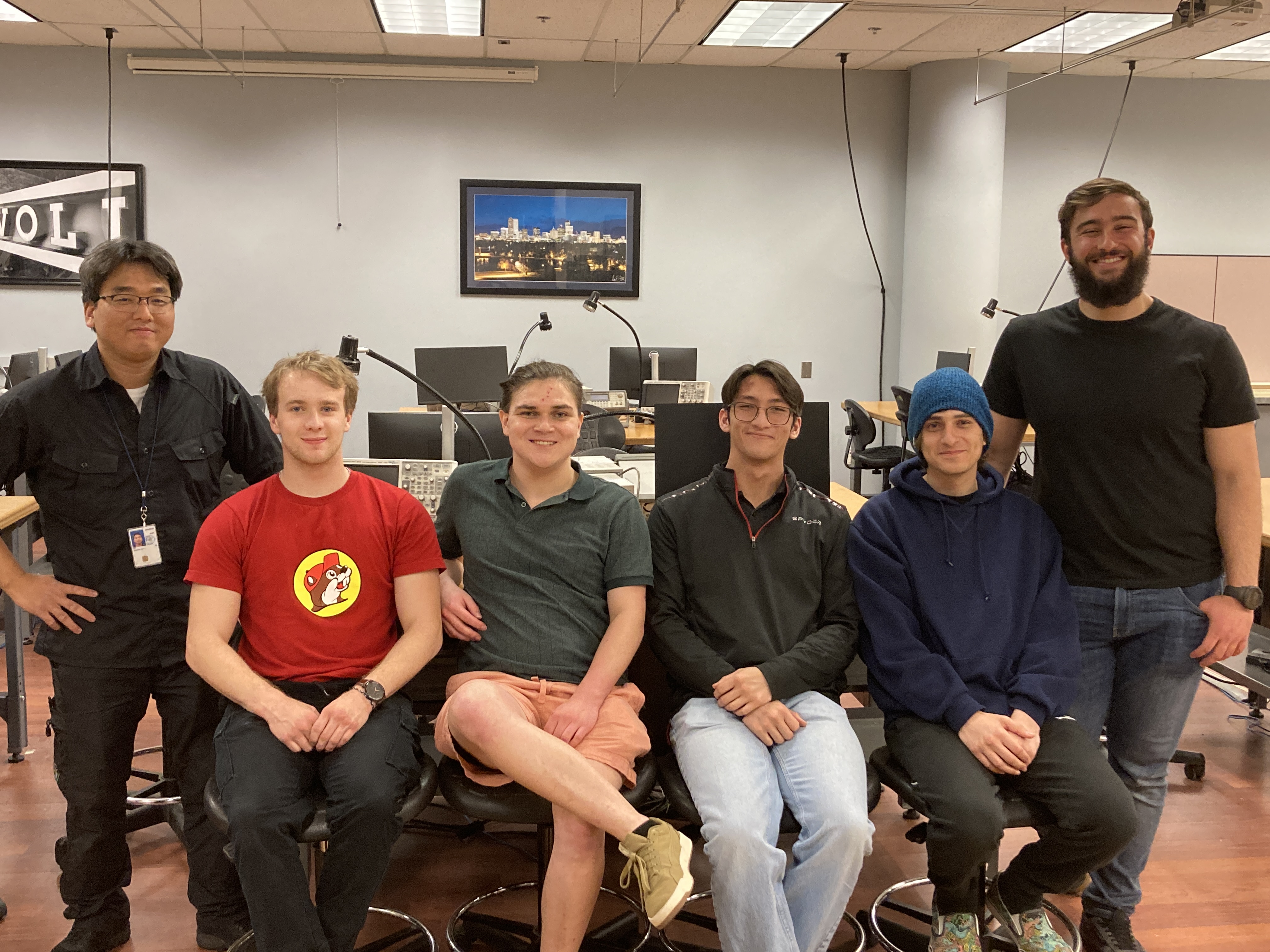
Liquid Antenna team

Lost Outdoors team
Categories
Discover more from College of Engineering, Design and Computing News
Subscribe to get the latest posts sent to your email.

CU Denver Engineering, Design and Computing View All
At the CU Denver College of Engineering, Design and Computing, we focus on providing our students with a comprehensive engineering education at the undergraduate, graduate and professional level. Faculty conduct research that spans our five disciplines of civil, electrical and mechanical engineering, bioengineering, and computer science and engineering. The college collaborates with industry from around the state; our laboratories and research opportunities give students the hands-on experience they need to excel in the professional world.
 College of Engineering, Design and Computing News