

A Quantum Leap Toward Gamma-Ray Lasers—and the Multiverse—Starts Here
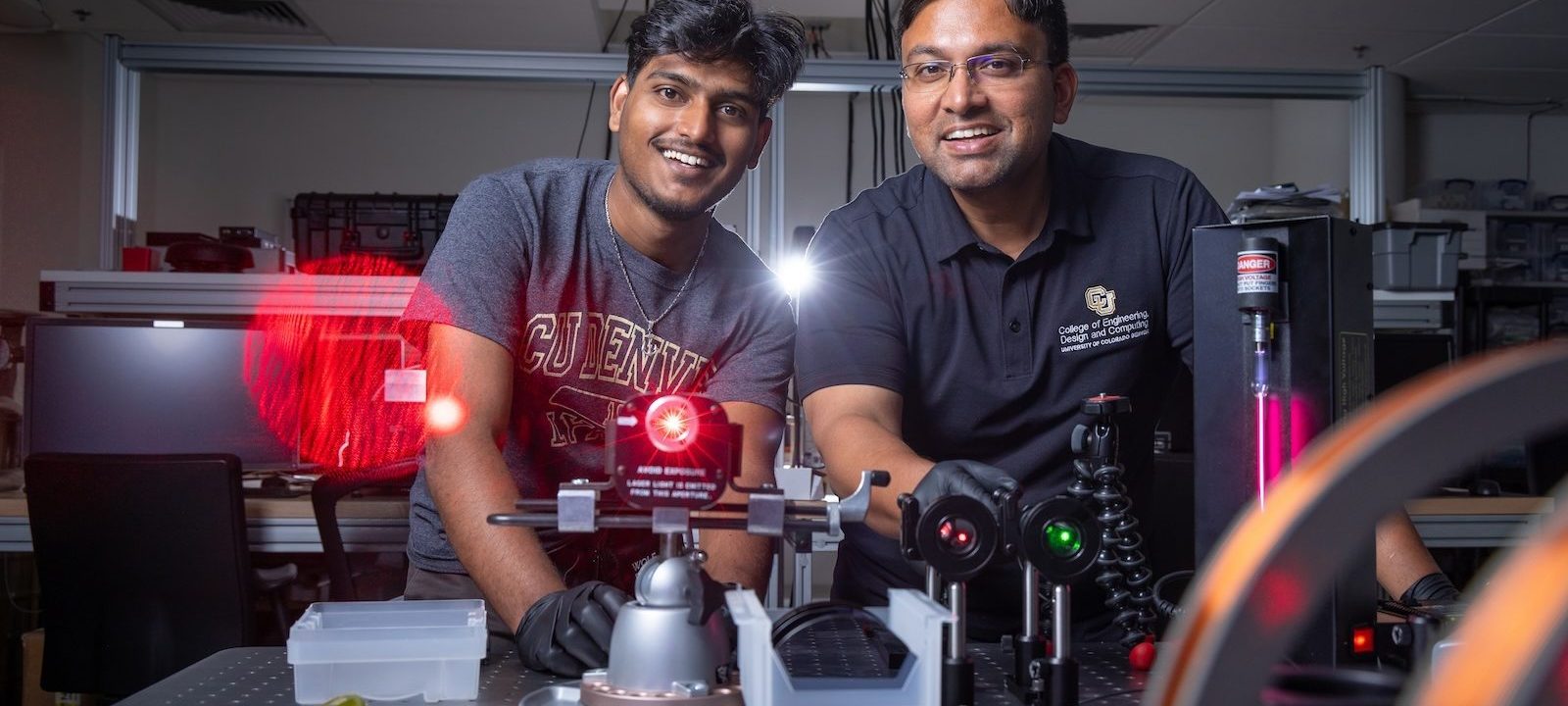
The College of Engineering, Design and Computing (CEDC) is generating innovations that may help turn science fiction into science fact. In a major advancement for quantum physics and materials science, Assistant Professor Aakash Sahai, PhD, has developed a silicon-based material capable of generating extreme electromagnetic fields at a scale never before possible in the lab.
Featured on the cover of Advanced Quantum Technologies, Sahai’s discovery could open the door to gamma-ray lasers that eliminate cancer cells with surgical precision without damaging surrounding tissue, imaging tools powerful enough to visualize atomic nuclei, and experimental systems capable of testing fundamental theories about the universe — including the existence of the multiverse.
This isn’t science fiction. This is CU Denver engineering in action.
Engineering the Impossible in the Palm of Your Hand
Until now, generating the extreme conditions required for high-energy particle and quantum experiments meant relying on massive infrastructure — like the 16.7-mile-long Large Hadron Collider buried beneath the Swiss countryside. Sahai’s chip-scale device changes that paradigm.

Using a silicon-based material roughly the size of a human thumb, the platform harnesses rapid quantum oscillations of electrons to replicate those same high-energy conditions. The result: a compact, stable and controllable system with the potential to revolutionize research across medicine, physics and materials science.
“This technology will open up whole new fields of study,” Sahai said. “In the past, we’ve had technological breakthroughs that propelled us forward such as the sub-atomic structure leading to lasers, computer chips, and LEDs. This innovation, which is also based on material science, is along the same lines.”
Why CU Denver and Why Now
This transformative innovation was designed and developed at CU Denver with funding from CEDC. The technique was tested at the world-renowned SLAC National Accelerator Laboratory at Stanford, which is funded through the U.S. Department of Energy.
This collaboration reflects the CEDC’s commitment to accessible, hands-on, and forward-looking research. Whether applying for patents, testing new materials, or shaping tools to explore the quantum frontier, CEDC students don’t wait to make an impact—they’re already doing it.
Graduate student Kalyan Tirumalasetty, a member of Sahai’s research team, summed it up: “Engineers give scientists the tools to do more than understand… that’s exhilarating.”If you’re ready to engineer not just your future, but the future—of medicine, of materials, and of the universe itself—CU Denver’s CEDC is where it starts. Because here, we don’t just study breakthroughs. We create them.

Categories
Discover more from College of Engineering, Design and Computing News
Subscribe to get the latest posts sent to your email.

CU Denver Engineering, Design and Computing View All
At the CU Denver College of Engineering, Design and Computing, we focus on providing our students with a comprehensive engineering education at the undergraduate, graduate and professional level. Faculty conduct research that spans our five disciplines of civil, electrical and mechanical engineering, bioengineering, and computer science and engineering. The college collaborates with industry from around the state; our laboratories and research opportunities give students the hands-on experience they need to excel in the professional world.
 College of Engineering, Design and Computing News