

From Inbox to Outer Space: CU Denver Engineering Student Joins International Space Research Mission in Sweden
Sometimes when opportunity comes knocking, it comes in the form of an email. Or at least it did for CU Denver electrical engineering student Sam Post when he opened an email about international research opportunities from his department last August.
“I was interested when I saw the email,” says Post. “I was really just curious about having a unique senior design experience.”
Within weeks of applying, Sam learned he had been selected to join an international research experiment based in Sweden, an experience that would take his classroom learning to the edge of space.Engineering for the Edge of Space
Engineering for the Edge of Space
Today, Sam is part of a multidisciplinary team working with the Swedish Space Corporation (SSC, University of Colorado Colorado Springs, and Linköping University to tackle one of the biggest health mysteries in space exploration: why astronauts’ immune systems seem to weaken in microgravity.
Their experiment, scheduled for launch in Fall 2026, will send T-cells, vital immune cells, into microgravity to study how they adhere to infected cells — a process critical to immune response. Understanding how microgravity affects this process could help bring insight for what causes weaker immune system responses in microgravity and help provide potential solutions to combat illness on long-duration missions to the Moon, Mars, and beyond.
Their compact 10x10x10 cm experimental payload will fly aboard a sounding rocket to capture live video of cell adhesion under near-zero gravity conditions. The results could not only inform medical protocols for space missions but also lead to new insights into immune system function here on Earth.
“It’s exciting,” says Post. “Having the opportunity to put my efforts towards a real world project and something that will potentially end up in microgravity is crazy to think about.”
A Global, Multidisciplinary Collaboration
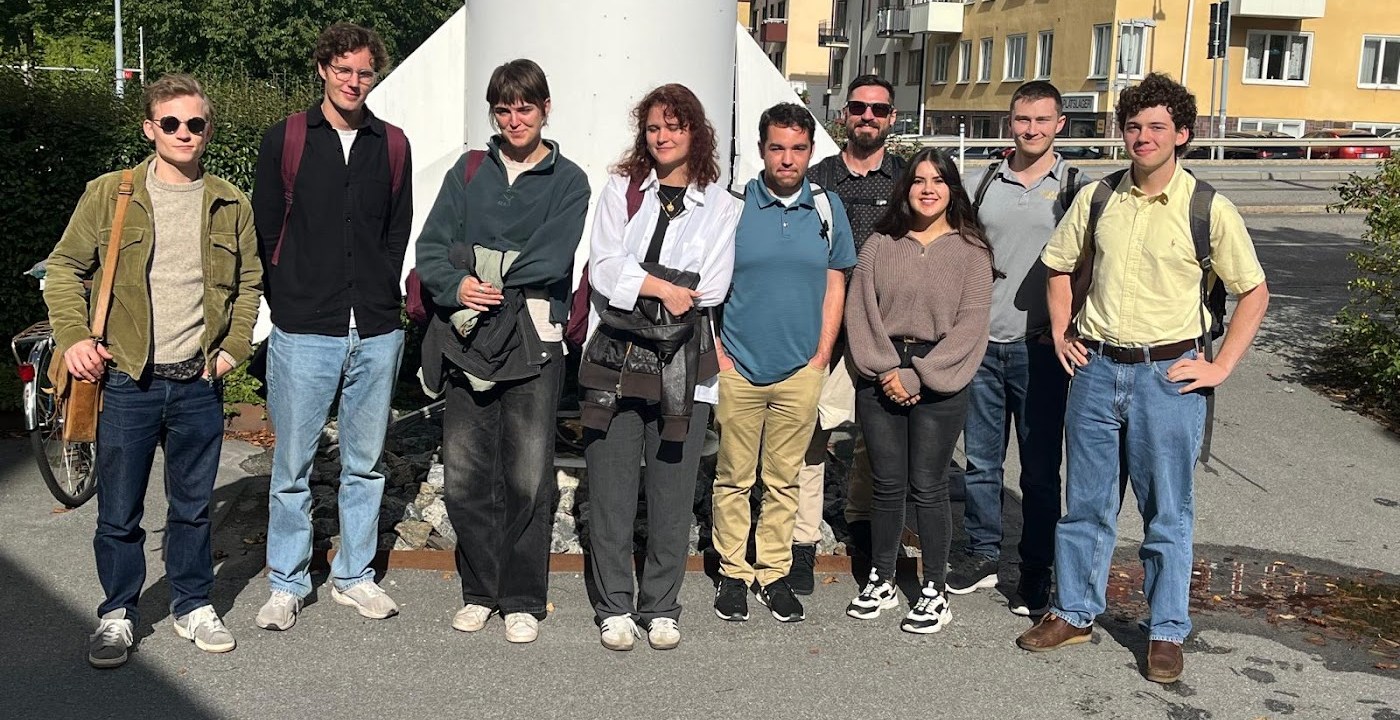
Sam was one of two CU Denver students selected for the Sweden research experience, joining peers from UCCS and a few Swedish universities. Over several weeks the team had met in Sweden, been briefed on the project and now have been working on investigating and designing solutions to make an autonomous experimental system
As the project’s only electrical engineer student, Sam is taking the lead on designing and optimizing the electronics systems, ensuring that the cameras capturing cell behavior and the equipment that executes the experiment will operate efficiently.
“My role was figuring out how to power these elements without exceeding our limited energy budget,” he explains. “It was funny because we were first briefed on the project I was thinking about power and how to actually control the experiment, while Tyler, my other CU Denver team member, was wondering how to regulate temperature so the cells wouldn’t die. That’s when it hit me how different disciplines bring insight to different perspectives on the project challenges.”
Through collaboration and creative problem-solving, Sam gained first-hand experience working in a high-stakes research environment, one that mirrors the kind of global, multidisciplinary teamwork driving today’s most innovative engineering solutions.
Building a Foundation for Success
CU Denver offers students a wealth of programs designed to launch careers and provide real-world experience, and Sam has taken full advantage of them. As part of the selective Electrical Engineering (EE) Scholars Program, he participates in a cohort of highly motivated peers who gain early exposure to advanced coursework and collaborative projects that help develop technical skills and professional confidences.
In CU Denver’s Magnetics Lab, Sam gains hands-on research experience, exploring projects that go beyond the traditional undergraduate curriculum and preparing him for a variety of career paths. Beyond the lab, he engages with programs like the ARCS Scholars initiative and student organizations such as Tau Beta Pi, connecting with peers, faculty, and industry opportunities while building the skills and relationships that support innovation-driven careers.
“I am still very early on in my engineering career, with only four years under my belt, but I am excited to see what is possible as I continue my degree,” he says.
With graduation approaching, Sam plans to pursue an industry internship to explore career paths beyond academia, building on the skills and experiences CU Denver has helped him cultivate. “Electrical engineering lets me do all kinds of things,” he adds. “The degree has provided me with a broad knowledge in many topics, but also has given me the opportunity to apply my effort to new ideas and problems.”
From Denver to the World
Sam’s journey is a powerful example of how far a CU Denver engineering education can take you—whether that’s across the globe or to the edge of space. Through dedicated faculty mentorship, hands-on research, and international collaboration, CU Denver’s College of Engineering, Design and Computing empowers students to turn classroom knowledge into world-changing innovation. For aspiring engineers ready to make an impact that reaches beyond boundaries, CU Denver is where those possibilities begin.
Your path to real-world research, global collaboration, and career-defining opportunities starts here. Explore CU Denver College of Engineering, Design and Computing and start building what’s next.
Categories
Discover more from College of Engineering, Design and Computing News
Subscribe to get the latest posts sent to your email.

CU Denver Engineering, Design and Computing View All
At the CU Denver College of Engineering, Design and Computing, we focus on providing our students with a comprehensive engineering education at the undergraduate, graduate and professional level. Faculty conduct research that spans our five disciplines of civil, electrical and mechanical engineering, bioengineering, and computer science and engineering. The college collaborates with industry from around the state; our laboratories and research opportunities give students the hands-on experience they need to excel in the professional world.
 College of Engineering, Design and Computing News