

From a Fifth-Grade Dream to Real-World Impact: How CU Denver Turns Curiosity Into Purpose
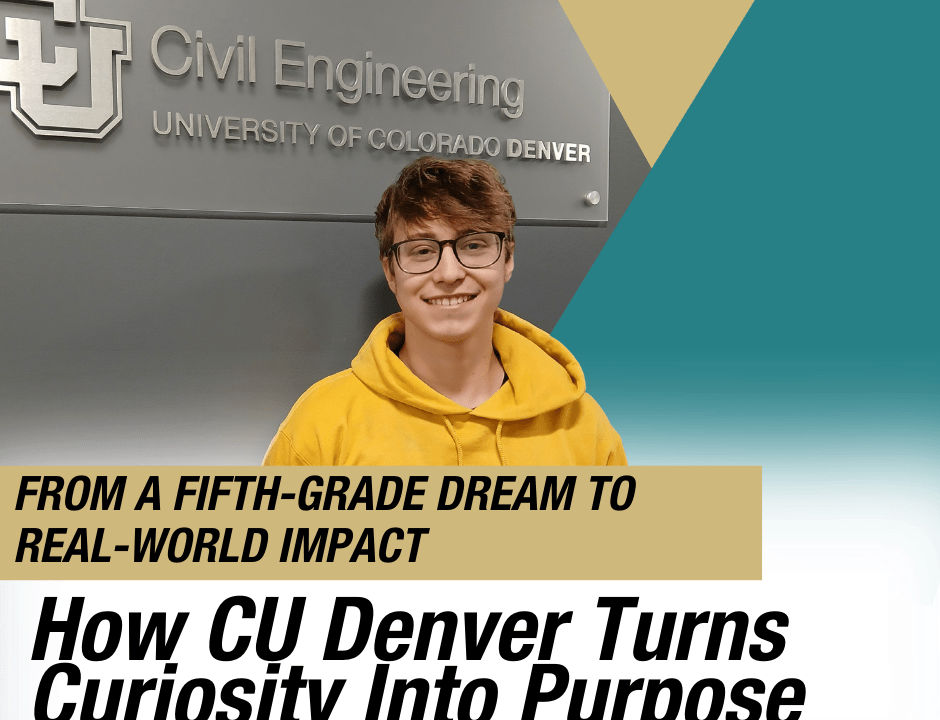
“Aaron Sullivan Stremel’s academic journey is a powerful testament to resilience and the impact of dedicated support systems,” says mechanical engineering associate professor Maryam Darbeheshti.
At the University of Colorado Denver’s College of Engineering, Design, and Computing (CEDC), student success is not accidental. It is built through intentional mentorship, hand-on learning, and a community of support.
Recent Outstanding Graduate Aaron Sullivan Stremel’s journey makes that philosophy tangible. From a fifth-grade dream to graduate-level research and professional impact, his story illustrates what happens when curiosity meets challenge, and when challenge is met with sustained support.
The Compass of Curiosity
For Aaron, engineering was never just equations or infrastructure; it was about meaning. Long before he knew exactly what an engineer did, he knew what mattered to him.
“Starting all the way back in 5th grade, I decided I wanted to be an environmental engineer. I had no idea what it meant, though I was sure it had something to do with protecting the environment and fish in the ocean, which are things that I was (and continue to be) very passionate about,” says Sullivan Stremel.
That sense of purpose set the stage for a journey that would define the CU Denver experience: curiosity paired with opportunity, challenge met with support, and education translated into real-world impact.
Early Momentum, Real Direction
By the time Aaron arrived at CU Denver, he was motivated, capable and ready to work hard.
“I attended a science, engineering, technology, and math (STEM)–focused middle school, where I stayed through high school because of the passion for engineering and science I was developing, specifically civil engineering.”
As a first-year student, Aaron joined the Engineering Learning Community (ELC), supported by the Scholarships in STEM (S-STEM) program through the U.S. National Science Foundation. The program brings students into a cohort model built around connection, mentoring and shared success.
“Joining the Engineering Learning Community (ELC) as an undergraduate freshman, Aaron navigated the rigorous demands of a civil engineering curriculum while overcoming significant initial challenges at CU Denver,” says Darbeheshti.
What stood out most to Aaron was the culture of collaboration rather than competition. “This was a great opportunity, especially because I am of the belief that life is too competitive in many ways, especially in school… My high school was competitive like this, and so the community formed by the ELC was nice because it was nothing except supportive,” Sullivan Stremel says. “Your cohort, your mentors, and the supervisors all wanted to help you.”
From Pause to Purpose
Even with strong support, Aaron’s first semester was difficult. “Unfortunately, that first semester, between COVID and some personal issues, I did not do well in my classes and ended up leaving CU for a semester,” he says.
Rather than closing doors, that moment became part of a longer journey, one shaped by experience and encouragement to return stronger. During his time away, Aaron gained hands-on industry experience in environmental consulting that brought engineering to life.
“I got a job working in environmental consulting, where I got to do everything from site assessments, to wetland delineations, to bird surveys (which meant I was up and sitting in a field at 4 am),” Sullivan Stremel says.
The work confirmed what he had always felt: engineering mattered—and so did finishing his degree. “It was a fantastic opportunity, but my boss really pushed for me to go back to school, and so I did, with an invigorated spirit and a desire to really learn and absorb what I could about engineering, especially as it pertained to water,” he adds.
Returning Not Just to Succeed, But to Lead
When Aaron returned to CU Denver, he rejoined the ELC, this time as a mentor. “After a semester, I was graciously offered the ability to come back to the ELC, not just with the scholarship funding, which was beyond appreciated, but now as a mentor,” he says.
Academically, Aaron hit his stride. “I was doing a lot better in my coursework, finally knew what an environmental engineer did, and really began diving deep into topics I liked: hydrology and hydraulics, geographic information systems (GIS), and even designing structures for the ocean,” Sullivan Stremel says.
A course in ocean structures led to his first formal research opportunity. “Professor Jackson Wang , who taught the ocean structures course, offered me my first formal research opportunity, doing a study on virtual reality (VR) … in a floating structure, a really unique experience,” he says.
The impact was immediate and lasting. “Before this, I had always felt like research would be interesting, and this helped me realize it was what I wanted to do.”
Excellence in Graduate Engineering
That realization carried Aaron into graduate study at CU Denver, where he worked in the groupof civil engineering and construction associate professor David Mays.
“Working with Aaron has been an invigorating experience that brilliantly demonstrates how a student can integrate the various components of their training, especially mathematics and programming, to make an original and creative contribution to engineering research,” writes Mays.
“Aaron identified the need for a mathematical proof, which he produced, programmed, and wrote into his master’s thesis,” he writes. “I am not the least bit surprised that he has our department’s highest GPA.”
Mays adds, “beyond the technical, he has been a great team player through his employment in the department. I am proud to be his master’s thesis advisor.”
Civil engineering and construction chair Kevin Rens echoes that sentiment. “I have enjoyed observing and participating in Aaron’s journey over the past several years,” says Rens. “It has been a pleasure to witness the growth and accomplishments. I look forward to seeing what exciting opportunities lie ahead.”
Building the Future and Giving Back
Today, Aaron is doing exactly what CU Denver aims to prepare its students to do: applying his education to real-world challenges while continuing to grow.
“From here, I am hopeful to pursue a PhD and continue with research but until then I am staying at CU, now as a lecturer while working as a water engineer for the Town of Castle Rock,” he says.
The CU Denver Difference
Aaron’s story is not about a straight line, it’s about momentum, mentorship and a university that meets students where they are and helps them go further.
Aaron’s journey reflects true strengths of the CU Denver College of Engineering, Design, and Computing: personalized mentorship, applied research, industry-connected learning, and a culture that supports students through challenge and change.
From a fifth-grade dream to graduate-level research and professional impact, CU Denver helped Aaron chart a path toward meaningful work.
Ready to start your own engineering story?
Explore CU Denver’s College of Engineering, Design, and Computing and discover how faculty mentorship, hands-on learning, and real-world experience can shape your future. Apply today and build what’s next.
Categories
Discover more from College of Engineering, Design and Computing News
Subscribe to get the latest posts sent to your email.

CU Denver Engineering, Design and Computing View All
At the CU Denver College of Engineering, Design and Computing, we focus on providing our students with a comprehensive engineering education at the undergraduate, graduate and professional level. Faculty conduct research that spans our five disciplines of civil, electrical and mechanical engineering, bioengineering, and computer science and engineering. The college collaborates with industry from around the state; our laboratories and research opportunities give students the hands-on experience they need to excel in the professional world.
 College of Engineering, Design and Computing News