

Where Mentorship Meets Momentum
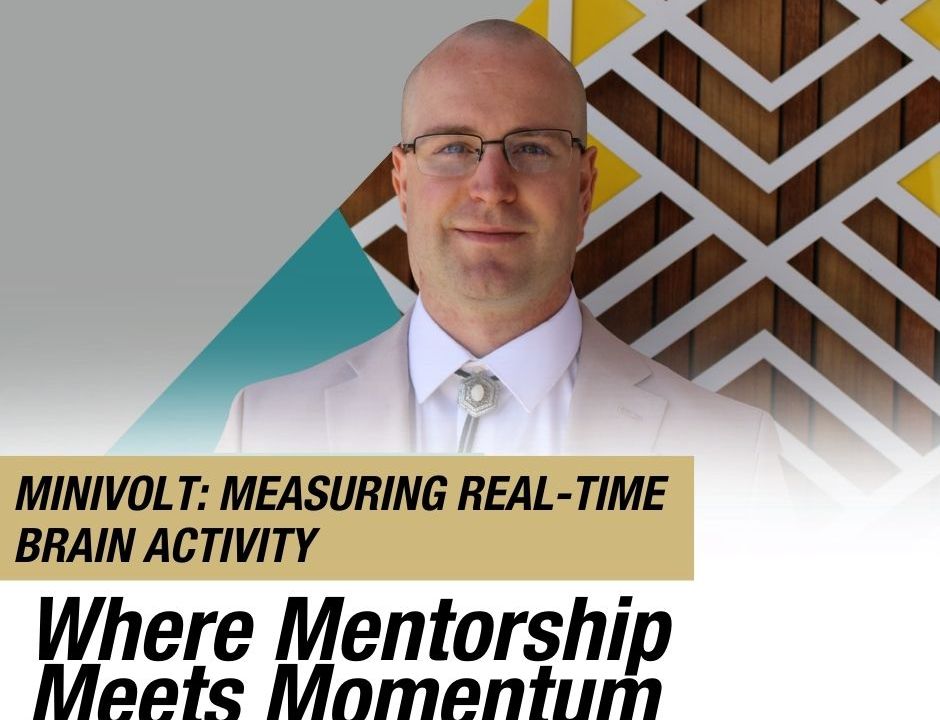
At CU Denver’s College of Engineering, Design and Computing (CEDC), a PhD is not an isolated academic exercise. It is an immersive, mentor-driven experience designed to help students pursue ambitious ideas, collaborate across disciplines, and graduate prepared to lead in their field.
That philosophy is not aspirational. It is foundational. For Forest Speed, it transformed a deep interest in photonics into a life-defining doctoral experience, a breakthrough research contribution, and a career in biomedical engineering where his work is expanding how scientists understand the brain and how future treatments for neurological and neurodegenerative disorders may be developed.
From Curiosity to Calling
Before coming to CU Denver, Forest was already on a strong academic path. He had completed a master’s degree in electrical engineering at CU Boulder. Yet he felt drawn to something more purposeful.
“I was specializing in photonics,” he said. “I wanted to build the same types of photonic systems but was feeling intrinsic motivation to do it for medical and neuroscience reasons.”
Rather than following a traditional engineering trajectory, Forest reached out directly to Professor Emily Gibson, PhD, whose work aligned with both his technical background and his growing interest in biomedical impact. “I reached out and ended up joining the PhD program in Emily’s lab after that,” he said.
Engineering a Tool That Sees the Brain in Motion
Forest’s doctoral research would place him at the center of an ambitious, multi-institutional effort to solve a long-standing challenge in neuroscience: capturing the brain’s electrical activity in real time, in awake and freely moving animals.
The result was MiniVolt, a tiny, lightweight microscope capable of capturing neuronal voltage signals, electrical spikes that occur in milliseconds, with unprecedented speed. Unlike traditional miniature microscopes that track slower calcium signals, MiniVolt captures voltage activity at hundreds of frames per second, revealing not only when neurons fire, but the subtle electrical changes that build up before firing.
“What makes this specific microscope really special is it’s very high bandwidth. You have to go really, really fast because action potentials are less than a millisecond long,” said Speed. “That’s really important for a lot of neuroscience experiments where the neuroscientist wants to know what different neural circuits are being activated during different behavior tasks.”
Shrinking that capability into a device small enough to move with an animal presented enormous engineering challenges.
“There are huge engineering challenges to bring the form factor of a voltage imaging microscope down to a size where it can be used with freely moving animals,” Speed said.
Trusted with systems-level responsibility, Speed helped design and integrate complex electrical and optical components—exactly the kind of hands-on, high-impact work that defines the CEDC PhD experience.
“That project really required a lot of systems-level engineering of electrical and optical systems,” he said. “It was something I was a great candidate for.”
An R1 Research Network That Accelerates Impact
The MiniVolt project reflects CU Denver’s position within one of the nation’s most dynamic health and innovation ecosystems. The work brought together engineers and neuroscientists across CU Denver, CU Anschutz, CU Boulder, and Columbia University, leveraging expertise that no single lab could provide alone.
“This is not something we did alone,” Speed said. “That’s really the beauty of R1 medical research, you’re able to have so many experts and so many disciplines working together.”
Published in Biomedical Optics Express, the research demonstrated that MiniVolt could reliably capture voltage signals in awake animals with signal quality comparable to standard benchtop microscopes. By enabling researchers to observe both rapid electrical spikes and subtle sub-threshold voltage changes, the tool opens new pathways for studying learning, memory, and behavior and ultimately for developing new treatments for neurological and neurodegenerative diseases.
Mentorship That Shapes Engineers—and Futures
For Forest Speed, however, the heart of his PhD experience wasn’t just the technology. It was mentorship.
From their earliest conversations, Emily Gibson’s guidance shaped his technical development and his growth as a researcher.
“Before I joined her lab, she was happy to Zoom with me, run through slides, and explain how different photonic systems were applied,” Speed said. “She’s one of the coolest people ever and an absolute leader in the field.”
Mentorship in Gibson’s lab extended beyond instruction. It was collaborative, iterative, and deeply human.
“For Emily in particular, she’s one of the best mentors you could ever imagine. It’s hard to even describe with words… the best experience ever, where someone is training you, supporting you, also learning with you, and you have this multi-dimensional relationship,” says Speed. “That type of grad student mentorship is really special.”
“So many of my favorite experiences were just hanging out in Emily’s office, putting equations on the whiteboard and trying to figure stuff out,” he adds.
From PhD to Immediate Career Impact
CEDC PhD students don’t wait until graduation to enter the professional engineering community. They publish, present, and build networks that translate directly into career momentum.
Today, Speed is a Staff Engineer at a company developing advanced microscopes for biological and pharmaceutical applications, continuing similar work to that he began during his PhD.
“Working in Emily’s lab really made it so that I could be an expert in a very small community of people,” he said. ““I’m applying the same toolset that I developed and utilized during my PhD. The entire experience prepared me incredibly for what I’m doing now.”
Build What’s Next
Forest’s story captures what sets CU Denver’s College of Engineering, Design and Computing apart: award-winning faculty who are dedicated to student success, an R1 research environment built on collaboration, and doctoral training that translates directly into career momentum.
If you’re looking for a PhD program defined by mentorship, opportunity, collaboration, and real-world impact—this is where that journey begins.
Explore Bioengineering PhD programs at CU Denver’s College of Engineering, Design and Computing.
Categories
Discover more from College of Engineering, Design and Computing News
Subscribe to get the latest posts sent to your email.

CU Denver Engineering, Design and Computing View All
At the CU Denver College of Engineering, Design and Computing, we focus on providing our students with a comprehensive engineering education at the undergraduate, graduate and professional level. Faculty conduct research that spans our five disciplines of civil, electrical and mechanical engineering, bioengineering, and computer science and engineering. The college collaborates with industry from around the state; our laboratories and research opportunities give students the hands-on experience they need to excel in the professional world.
 College of Engineering, Design and Computing News