

CU Denver Electrical Engineering Students Present Research at National Radio Science Meeting
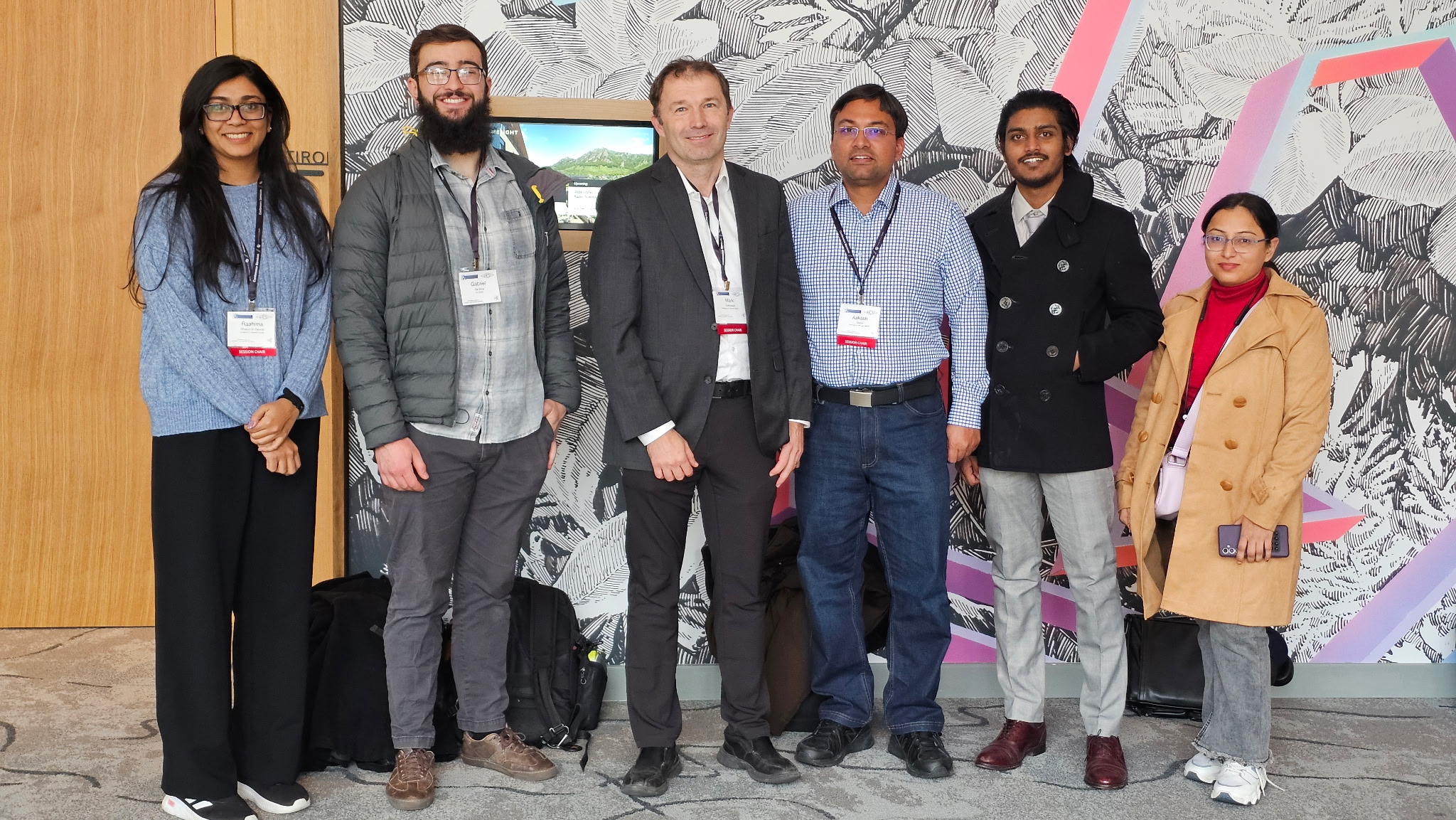
Each year, the U.S. National Committee of the International Union of Radio Science (USNC-URSI) convenes engineers and scientists from across the country who are advancing the frontiers of applied electromagnetics, radio science and related fields at the National Radio Science Meeting (NRSM). For students and faculty in the Electrical Engineering Department within CU Denver’s College of Engineering, Design and Computing (CEDC), the annual meeting is more than a professional conference—it is a proving ground where classroom learning, faculty mentorship and funded research converge in real-world practice.
This year, CU Denver students presented original research alongside faculty and peers from research institutions nationwide, contributing to the national research dialogue.
For CU Denver students, the National Radio Science Meeting offers a rare opportunity to participate directly in the national research conversation. “Students are deeply involved in the research we’re doing,” said Mark Golkowski, chair and professor of electrical engineering. “The students carry out the experiments and perform data analysis.”
Undergraduates and Graduates Collaborating Closely
Small class sizes and close faculty relationships mean undergraduates gain early exposure to engineering projects and research happening through the university. This structure creates opportunities not only for graduate students, but also for undergraduates, to engage in cutting-edge work early in their academic careers.
This year, the department was represented at the NRSM by graduate students Gabriel Da Silva (MS), Malek Abusinina (MS), Raahima Khatun-E-Zannat (PhD), and Kaylan Tirumalasetty (PhD), along with Professor Sahai.
Undergraduate students also played a role. Alex Sanderfeld (BS) prepared an excellent presentation on his field observations, but was unable to attend as he was in Taiwan and Japan for a study abroad course. His participation reflects a broader departmental approach in which undergraduates are integrated into active research efforts alongside graduate students and faculty.
Conferences like this one then become a natural extension of that experience, places where students learn to communicate their findings, defend their ideas, and connect their work to a national and international research landscape.
Research That Matters
CU Denver faculty and students presented work in two key research areas. One focus centered on the science of probing the near-Earth space environment with radio waves, an area of increasing importance as more satellites and space-based infrastructure become embedded in global communication, navigation, and security systems. Understanding how space weather and electromagnetic phenomena affect these technologies is critical to protecting modern infrastructure and national interests.
The second area addressed high-energy beam interactions with materials, a field that helps answer fundamental questions about the physics of matter. This work involved experiments at the SLAC National Accelerator Laboratory and contributes to the foundational scientific understanding that supports future technological advances.
Together, these research themes highlight how CU Denver Electrical Engineering balances applied relevance with foundational discovery, preparing students to contribute to both immediate engineering challenges and long-term scientific inquiry.
Students at the Center of Discovery
A defining characteristic of the department is the central role students play in faculty research. Students participate in experiments, data analysis and interpretation through projects funded by the National Science Foundation, Department of Defense and other external sponsors.
Golkowski described the collaborative environment fostered at the NRSM: “I think what is inspiring is that attending the conference brings together faculty, graduate students, undergraduate students, and visiting scholars together as a team. Everyone is highly supportive of each other despite different levels of experience. Some are nervous about giving their first professional presentation, others are trying to network a career start after graduation. Faculty are trying to get insights on future tech trends and funding opportunities. All get to interact with peers from around the country who are working on similar research challenges.”
The conference also underscores the long-term impact of CU Denver’s Electrical Engineering program. The URSI organization serves as a powerful point of connection between current students and alumni who are now advancing the field nationally as researchers, faculty members, and leaders in the profession.
“The conference also brings together CU Denver alumni in the field of Radio Science,” Golkowski said. “Joseph Gedney graduated with his BS from CU Denver but was at the conference as a PhD student from Ohio State, and Ashanthi Maxworth who is now a professor at University of Southern Maine got her MS and PhD at CU Denver. She was at the conference and is an officer in the professional organization that organizes the conference.”
That continuity reflects more than professional networking, it demonstrates a clear pipeline from education to advanced research careers. CU Denver alumni have consistently earned national recognition through URSI’s competitive student paper awards, including Joseph Gedney (second place, 2026), Poorya Hosseini (third place, 2019), and Ashanthi Maxworth (tied for first place, 2017).
For current students, seeing alumni return as presenters, faculty leaders, and award recipients reinforces what is possible: that research experiences at CU Denver translate into sustained success and leadership in engineering and science.
“CU Denver Electrical Engineering offers a wide range of opportunities for students to be trained and engage at the cutting edge of the discipline,” says Golkowski. “The consistent student and faculty participation in the National Radio Science Meeting is just one example of CU Denver Electrical Engineering being a recognized leader.”
Preparing Students for the Future
The takeaway is clear: in CU Denver’s Electrical Engineering department, research, teaching, and professional outcomes are tightly connected. Participation in national venues like the URSI NRSM reflects a program that is recognized, connected and forward-looking. Students who study at CEDC are not only learning engineering principles, they are applying them, presenting them, and contributing to the conversations shaping the future of science and technology.
Categories
Discover more from College of Engineering, Design and Computing News
Subscribe to get the latest posts sent to your email.

CU Denver Engineering, Design and Computing View All
At the CU Denver College of Engineering, Design and Computing, we focus on providing our students with a comprehensive engineering education at the undergraduate, graduate and professional level. Faculty conduct research that spans our five disciplines of civil, electrical and mechanical engineering, bioengineering, and computer science and engineering. The college collaborates with industry from around the state; our laboratories and research opportunities give students the hands-on experience they need to excel in the professional world.
 College of Engineering, Design and Computing News