

Studying AI Where Discovery Comes First
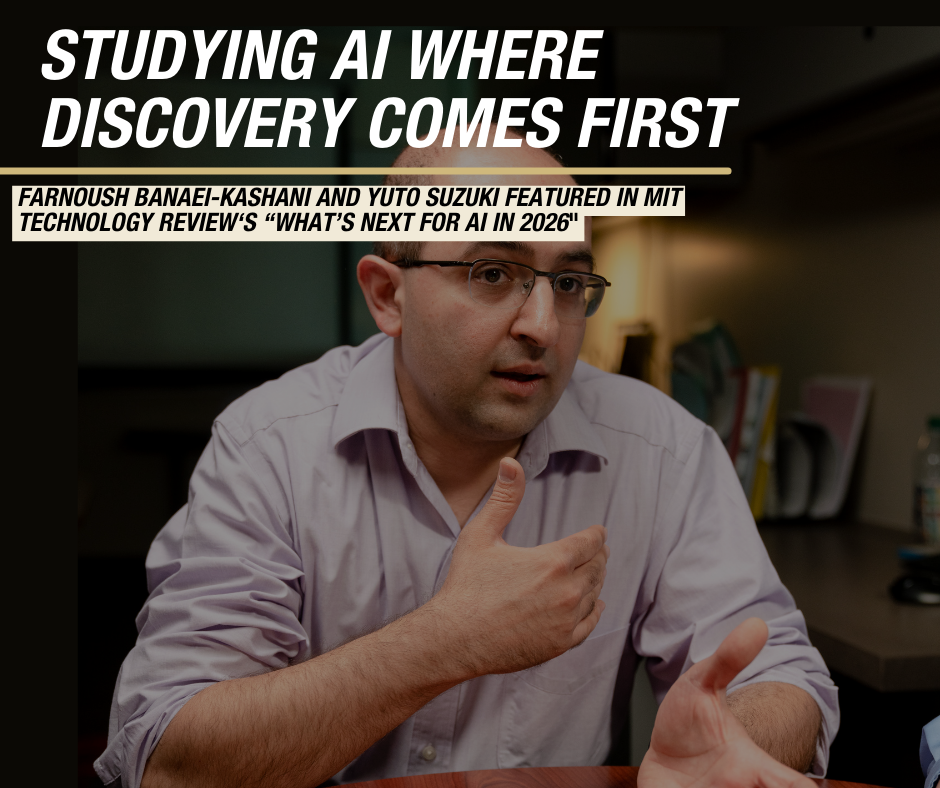
When conversations about the future of artificial intelligence focus on speed, scale, and automation, University of Colorado Denver researchers are asking a more fundamental question: Can AI generate truly new ideas? And if so, how do we make that creativity meaningful rather than chaotic?
That question recently placed CU Denver at the center of the AI conversation. Two CU Denver researchers, Farnoush Banaei-Kashani and Yuto Suzuki, were featured in MIT Technology Review‘s “What’s next for AI in 2026“, for their work on creative reasoning in large language models. The recognition underscores a growing reality: while coastal tech hubs often dominate AI headlines, Colorado researchers are helping define what comes next.
While some critics argue that LLMs can only remix the past, research at CU Denver shows that these systems can be pushed beyond imitation and toward discovery. With the right frameworks, AI can explore new ideas, challenge assumptions, and generate solutions that have never existed before.
Rethinking AI
“Typically, the way these tools are developed is by leveraging existing data, historically available data,” says Farnoush Banaei-Kashani, professor of computer science in the College of Engineering, Design and Computing at CU Denver. “The question that was raised was, OK, where do we go from here?”
That question lies at the heart of his recent paper, “Universe of Thoughts: Enabling Creative Reasoning With Large Language Models.” The research proposes a systematic method for encouraging AI systems to explore unconventional solutions before converging on an answer—making so-called “reasoning models” less conservative, more inventive, but still reliable.
As large language models have surged into everyday use, much of the field has focused on scale: bigger datasets, larger models, faster computation. Banaei-Kashani’s team takes a different approach, asking what these systems fundamentally can—and cannot—do.
“If these tools are starting to generate things and become the main way knowledge is produced,” he says, “are we going to stop developing knowledge or generating new knowledge because they are relying on what we’ve already produced? Everything they say is based on what we have already generated as human. So what would happen to innovation and creativity?”
Rather than treating that concern as a dead end, Banaei-Kashani treats it as a research challenge.
“We are innovative and creative creatures,” he says. “Based on whatever we understand, we try to develop new ideas. We wanted to see how we can leverage large language models to do exactly the same thing.”
That framing shapes research that treats AI not as a finished product, but as a system still learning how to explore, imagine, and discover. This is not AI as product development or incremental optimization, it is AI as a field still being defined, where assumptions are interrogated and rebuilt from the ground up.
Teaching AI to think creatively
In this work, Banaei-Kashani’s team draws on cognitive science study done by Margaret Bergman to break creativity into distinct, teachable mechanisms. He explains that there are three ways humans are creative and shows how each can be translated into computational form.
One approach resembles collage-making. “A collage painter brings in ideas from different people, adds more to it, places them in the right order, and something else pops out of it, the new concepts” he explains.
Another approach looks at changing the fundamentals. “Think about Monet or Van Gogh,” he says. “So that’s changing things, the basics and then redoing things.”
The most radical approach rewrites the rules altogether. “Picasso says, forget about portrait,” Banaei-Kashani explains. “As long as my drawing captures the general concept of a portrait, that should work fine. That changes the entire rule set for developing a new solution for a problem.”
By embedding these mechanisms into large language models, the research shows that AI systems can become significantly more innovative, outperforming both commercial and non-commercial tools on creative reasoning benchmarks.
“They can actually become creative,” Banaei-Kashani validates. “If you add creativity to a LLM, suddenly you can say, well, I don’t need to necessarily rely on a past line of work. I can leverage them, I can understand them.”
AI’s Next Breakthrough is Discovery
MIT Technology Review situates this research within a broader shift toward AI-driven discovery. While many AI systems prioritize automation and efficiency, CU Denver’s work emphasizes something different: opening new paths instead of accelerating old ones.
“There is recent work from places like DeepMind,” he says. “But we are different in terms of adding the angle of creativity to that story.”
That difference matters. Automation accelerates known paths; creativity opens new ones.
“This opens a new door,” Banaei-Kashani says, “for people to repurpose large language models for making new things and innovating.”
From Faster Answers to New Questions
Although the work is deeply theoretical, its implications are practical. One active application is drug discovery, where creative reasoning allows AI systems to explore regions of molecular design space that have never been examined.
This means using AI not just to evaluate known compounds faster, but to imagine entirely new molecular structures, revealing solutions traditional, data-driven methods may never surface. Instead of limiting exploration to well-mapped areas, creative reasoning enables these models to reveal potential solutions otherwise invisible to human researchers.
“There’s this other space. A part of the search space for that people have not ever historically, touched.” he says. “Creativity lets us explore that space.”
But Banaei-Kashani is clear that no single application defines the work. This technology could equally serve as an engine for producing innovative business ideas. The larger goal is to rethink how discovery itself happens.
Turning AI Into a Partner in Discovery
“Any sort of problem you throw at this LLM, it offers some solutions. The approach that we are offering is, can you think more creatively to come up with even a better solution that might not have been explored in the past,” says Banaei-Kashani.
“We want to close the loop,” he says, “from finding creative problems, to coming up with creative hypotheses, to generating creative solutions, to creatively evaluate them—and then repeating that cycle.”
This is the typical cycle for scientific discovery, however, what makes AI uniquely powerful in this context is scale. “They can look at the Library of Congress and come up with ideas in minutes,” he says. “Versus months and years for a human to go through each step.”
The result is a shift in how AI supports science: from accelerating existing workflows to actively expanding the boundaries of what researchers can investigate. It’s a model of AI as a collaborator in discovery—one that reflects CU Denver’s broader vision for how advanced computing can serve real-world impact.
Where Curiosity Drives AI Research
This is research driven by questions, not just tools. It is work that challenges assumptions about what AI can and cannot do—and invites students into that challenge.
“I hope people see this as a potential tool they can use to make discovery in their own domain,” he says.
“If [LLM’s] are creative, they’re going to be useful forever,” he says. “Solving some problems that have been sticking problems for years… If you think about them creatively, you can potentially come up with ideas to address them. So that impact could be there if this starts being adopted by communities and used.”
At CU Denver’s College of Engineering, Design, and Computing, that spirit of curiosity drives both research and learning. For students drawn to foundational questions, long-term impact, and the idea that AI’s future is still being defined, this is the place to help define what’s possible for the next generation of technology.
Categories
Discover more from College of Engineering, Design and Computing News
Subscribe to get the latest posts sent to your email.

CU Denver Engineering, Design and Computing View All
At the CU Denver College of Engineering, Design and Computing, we focus on providing our students with a comprehensive engineering education at the undergraduate, graduate and professional level. Faculty conduct research that spans our five disciplines of civil, electrical and mechanical engineering, bioengineering, and computer science and engineering. The college collaborates with industry from around the state; our laboratories and research opportunities give students the hands-on experience they need to excel in the professional world.
 College of Engineering, Design and Computing News