

From Design to Data: How CU Denver’s Outdoor Gear Program Helped One Student Meet His Moment
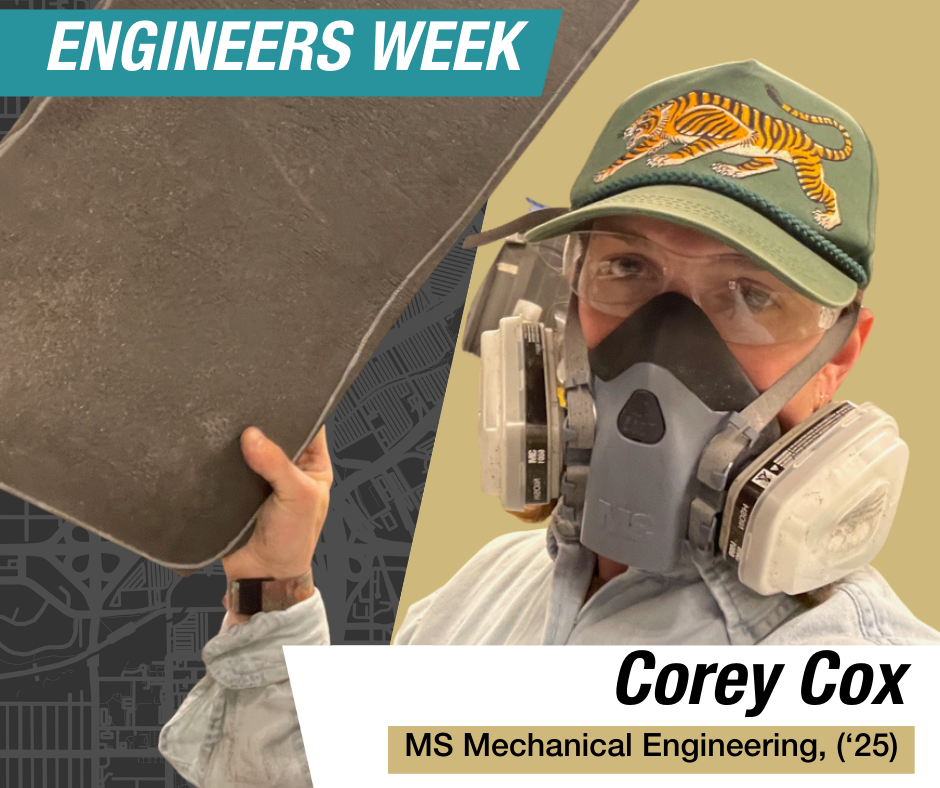
For Corey Cox, discovering CU Denver’s Outdoor Gear Design program was a rare moment when curiosity was met with opportunity.
“Finding out about the program was very much a story of ‘right place, right time,” said Corey Cox, recent Mechanical Engineering MS graduate. “My partner and I were at the first annual Outside Fest in Civic Center Park and happened upon the CU Denver tent with Ron Rorrer, Dana Carpenter, and Adam Trenkamp, of Outside Inc., sharing information about the newly concepted program.”
That program — the Outdoor Gear track within CU Denver’s Master of Science in Mechanical Engineering — was newly developed through a collaboration between the College of Engineering, Design and Computing and Outside Inc. Designed for students interested in the booming outdoor industry in Colorado, the program blends mechanical engineering fundamentals with hands-on product design, testing and real-world problem solving with state of the art machinery in the Outside Lab.
The demonstration that caught Cox’s attention was simple, but effective. “As a gear enthusiast and person always on the hunt for the perfect bag to hike, travel, and explore with, I was hooked,” Cox said.
A pivot made possible
At the time, Cox was working in graphic design, communications and marketing, but he was already questioning whether that path aligned with his long-term goals.
“I was eyeing new ventures outside of the current role I was in at the time,” Cox said. “Lucky for me the company decided I was no longer needed, before I could decide I no longer wanted the job!”
That moment of uncertainty gave way to a new possibility. CU Denver’s Outdoor Gear track, which allows students to pursue a mechanical engineering master’s degree without a prior engineering background, offered Cox something rare: a structured, supportive way to pivot into a technical field.
“It gave me an opportunity to shift my future career choices toward something I more aligned with and have an interest in, providing technical knowledge and thinking methods I didn’t previously have,” said Cox.
For CEDC, that flexibility is intentional. The college is committed to expanding access to engineering education while maintaining rigor, recognizing that innovation often comes from students who bring diverse perspectives into technical spaces.
Rising to the challenge
Transitioning from a design-focused background into a math-heavy engineering program was demanding.
“The most obvious challenge I knew I was going to face was playing catch up in such a math-heavy field,” Cox said. “With a background in graphic design, much of my bachelor’s degree was focused on conceptual thinking and relatively subjective decision making.”
The learning curve was steep. “It took me about three days to learn what most classmates picked up in one,” he said. Still, Cox welcomed the challenge. “Understanding more each week was incredibly motivating, it showed me I could comprehend engineering principles that once felt foreign.”
What made the difference was the ecosystem around him: faculty, peers and a college culture that treats student success as a shared responsibility.
“I wouldn’t have succeeded without support from friends and family and encouraging professors which allowed me time before and after classes to constantly repeat the same questions until I could realize an answer,” Cox said.
“My professors — Dr. Trevor Young, Dr. Ron Rorrer, Dr. Kristin Wood and Dr. Dana Carpenter — were such tremendous help throughout the entire program, not only giving me extra time and resources, but making sure my success felt as much their priority as it was mine,” Cox said.
Equally important was the support of classmates and cohort peers.
“I’m also extremely grateful for my countless classmates and cohort partner, Liz Roshkovskiy, who spent their own learning time to make sure I was caught up and understanding new material,” Cox said. “Both undergrad and grad students I was surrounded by lent their knowledge and time to constantly keep me inspired and help me grasp concepts I was struggling with.”
That collaborative, cross-level environment reflects CEDC’s broader approach: pairing academic rigor with access, mentorship and hands-on learning that mirrors how engineers work in the real world.
Learning to think like an engineer
Courses such as Intro to Product Design and Development, Lab Gear Testing and Composites helped Cox integrate his creative background with analytical engineering thinking.
“Within these three courses, I feel I’ve improved my conceptual thinking and decision making, hands-on data analysis, and engineering problem considerations when designing and building anything that has a safety factor or performance metric,” Cox said. “I truly took away valuable information from each course.”
For Cox, the program sharpened his ability to critically evaluate the outdoor industry itself.
“The Outdoor Gear program will allow you to learn key skills to better scrutinize and dissect decisions brands and manufacturers make when creating products or processes in the outdoor industry,” he said. “The program is great for someone who wants greater technical knowledge to solve problems and is willing to use all the resources available to connect and grow their own journey within the industry.”
Industry access is a defining feature of the program’s collaboration with the Outside Lab, giving students opportunities to engage directly with professionals shaping the field and access to cutting edge technologies.
“Not only do we have the ability to learn from world-class engineers and researchers at CU Denver, but being a student afforded me opportunities to connect with industry leaders and experts in a casual and non-competitive way,” Cox said. “Many people are willing to go above and beyond to advance a student’s learning if you approach them with an honest and open attitude.”
Confidence, carried forward
As one of the first few students to complete the Outdoor Gear program, Cox leaves CU Denver with more than a degree.
“I have not only gained industry relevant experience, knowledge, and professional support, but I now know I have the ability to quickly adapt, learn hard things, and the confidence to feel competitive in a field I had zero chances in before,” Cox said.
For prospective students questioning whether they are “ready,” Cox’s experience offers reassurance. “In every professional and learning experience in my life, I have experienced the dreaded imposter syndrome,” he said. “You quickly learn that so many others, even people in positions you wish to find yourself, experienced the same thing at least one point in their careers.”
Looking back, the leap was worth it.
“Though I feel I can’t say I’m a true engineer, yet, I am better off and smarter for having taken the risk and dedicated the past 18 months to a program I myself didn’t feel ‘ready’ or ‘right’ for.”
At CU Denver’s College of Engineering, Design and Computing, that leap — supported by innovative programs, committed faculty and an inclusive vision of who belongs in engineering — is exactly where student success begins.
Categories
Discover more from College of Engineering, Design and Computing News
Subscribe to get the latest posts sent to your email.

CU Denver Engineering, Design and Computing View All
At the CU Denver College of Engineering, Design and Computing, we focus on providing our students with a comprehensive engineering education at the undergraduate, graduate and professional level. Faculty conduct research that spans our five disciplines of civil, electrical and mechanical engineering, bioengineering, and computer science and engineering. The college collaborates with industry from around the state; our laboratories and research opportunities give students the hands-on experience they need to excel in the professional world.
 College of Engineering, Design and Computing News