
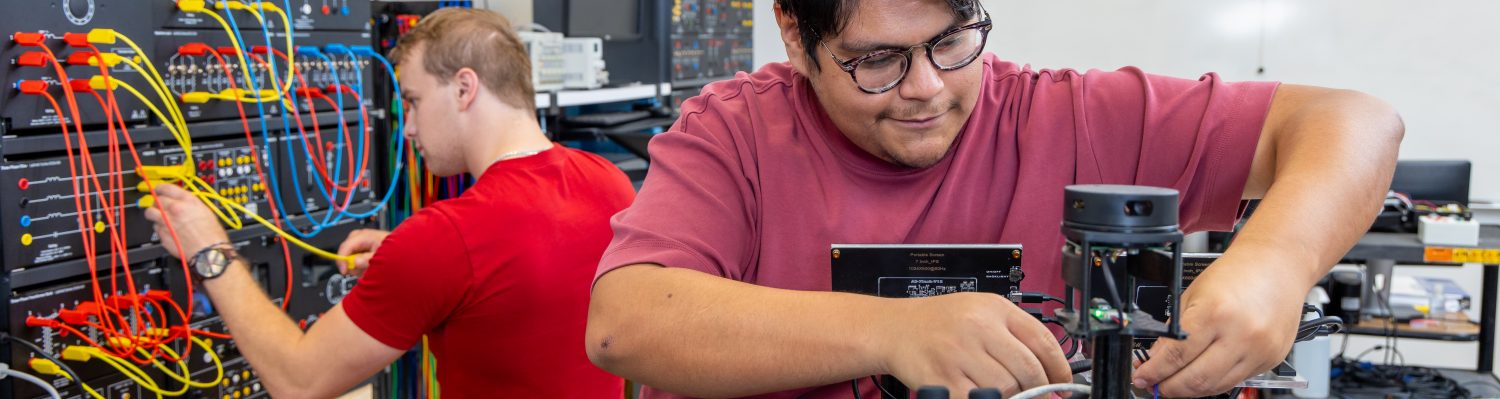
Engineering Transforms Our Future: Innovation for Every Ability at CU Denver’s CEDC
Engineering has always defined civilization. Roads determine where we travel. Power grids shape how we live. Water systems protect public health. Communications networks connect the world. Every generation of engineers builds the infrastructure that defines how we live, work, and connect.
At CU Denver’s College of Engineering, Design and Computing (CEDC), it means designing a world where technology works for everyone. Through the Center for Innovative Design and Engineering (CIDE), faculty, clinicians, researchers, and students are redefining what innovation looks like and who it serves.
“Our core mission is to catalyze technology solutions for people living with or aging into disability,” said Cathy Bodine, PhD, Director of CIDE and Professor of Biomedical Engineering. “It can be super, super low tech, something as simple as a pencil grip, all the way to using AI for smart home technology, using eye gaze to type, or alternate voice output for people who are nonverbal.”
That range tells a powerful story. The next great infrastructure challenge extends beyond bridges and broadband. It is accessibility. It is designing a world that is easier to live in, regardless of age or ability.
Engineering the Infrastructure of Independence
By 2050, an estimated 2.1 billion people worldwide will be living with a disability, near double today’s number. In a world of eight billion people, that means one in four individuals will experience disability in their lifetime. It is a defining engineering challenge of our era.
Meeting that moment will require more than innovation. It will require intention.
“In terms of our students, it’s really about creating the next generation of engineers so they can deal with the challenge,” says Bodine. “We’re going to need to really develop and deploy a tremendous number of technology solutions in order for people to be able to age in place… to be independent, to go to school, to go to work, to do whatever it is they want to do with their life.”
Older adults may not identify as having a disability, but they often face functional challenges like those experienced by younger individuals with disabilities. Engineering solutions must account for that reality. This is engineering as the infrastructure of independence.
A Model Unlike Any Other
What makes CIDE transformative is not only what it builds, but how it builds.
CIDE combines a rigorous academic program, a strong research program, and clinical expertise. “We have a clinic that serves individuals with disabilities focused on mainstream technology and assistive technologies. We have engineers. We have academics. We have research. And we blend those,” says Bodine.
Even more importantly, the work is grounded in lived experience. “We do it with a user-centered focus — meaning the person with the disability is a full partner, every bit as vital to the process as the clinicians or the engineers,,” says Jim Sandstrum, Research Senior Instructor and Industry Services Coordinator for CIDE.
Most innovation centers begin with a technical problem. CIDE begins with a person.
“When we allow the lived experience to guide our technical experts, we gain the ability to move beyond theoretical problem-solving to create tools that address the nuanced, real-world barriers that only those with lived experience can identify.,” adds Sandstrum. “And that approach results in innovation that benefit everyone.”
The integration of academics, research, clinical application, and lived experience is rare. The result is innovation built not just for people, but with them.
“I have looked everywhere and I have yet to find another program anywhere in the world like ours,” Bodine added. “This is how we’re going to be able to design effective technology solutions, by having that inclusive approach for everything.”
Designing the Future of Human-Centered Technology
At CIDE, accessibility is not a constraint on innovation. It is a catalyst.
Researchers are engaged in studies to engineer more accurate clinical measurement tools, build robotic applications, explore the impact of dynamic seating on wheelchairs, and investigate tools to improve sleep; all in an effort to improve the health and daily life for individuals with disabilities. One power wheelchair driving-support innovation that benefited from CIDE’s clinical insight was later named one of Time Magazine’s 100 Best Inventions of 2020.
Among the most promising areas of research is social assistive robotics.
“We’re deeply engaged in social assistive robotics to reduce social isolation and support therapeutic exercises for people recovering at home,” says Bodine. “The idea behind the social assistive robot… is reducing social isolation of people living alone or living with disabilities.”
The stakes are profound. “We know that social isolation has the same mortality rate as cardiovascular disease. So, this is a massive problem,” asserts Bodine.
These technologies do not replace human connection. They extend it. For someone recovering from a stroke or surgery, a robot that encourages exercises and engagement can mean the difference between stagnation and progress. This is engineering that addresses not only function, but dignity and quality of life.
Opening Gates to Opportunity
CIDE’s work extends into one of the most consequential gateways in modern society: high-stakes testing.
The center collaborates with producers of high school equivalency exam, professional certifications, and credentialing bodies to ensure that exam content and testing interfaces are accessible without compromising integrity.
The impact is profound. Accessibility in high-stakes testing can determine whether someone advances to law school, earns a certification, or enters a profession.
“We have accounts of people who have been waiting a year to take this exam, and they can’t because it’s not accessible,” Sandstrum shared. “Can you imagine going through college, graduating… and not being able to enter your profession?”
For someone who cannot use their hands, eye-gaze typing can mean the difference between silence and communication. For an older adult recovering from stroke, assistive robotics can mean the difference between isolation and engagement. For a professional facing an inaccessible certification exam, accessible testing technology can mean the difference between a career and a closed door.
Inclusive engineering changes life trajectories.
Raising the Bar for Industry
CIDE’s impact extends far beyond campus. For more than 15 years, the center has operated a product testing lab focused on usability studies and user testing. Faculty and students conduct pragmatic clinical trials and consult with industry partners across sectors.
“We consult with industry partners,” Sandstrum said. “We’re able to bring together populations of folks with different functional needs to provide the kind of feedback to our industry partners that they require to improve their products.”
This work has influenced clinical tools, consumer technologies, and mainstream products alike. More importantly, it has contributed to a broader cultural shift.
“There’s been a shift,” says Sandstrum, “From assistive technology as a side project… to assistive technology as a defining aspect of your product.”
“Accessibility is now mainstream,” Bodine confirms. “It’s one of the fastest growing career paths for engineering students.”
CU Denver engineers are not reacting to that shift. They are helping lead it. Within CEDC, accessibility and human-centered design are not electives. They are hallmarks of how engineering is taught, researched, and practiced. Students graduate fluent not only in technical rigor, but in empathy, user research, and inclusive design principles. They enter the workforce prepared to lead in accessibility, human factors, rehabilitation engineering, and inclusive product development.
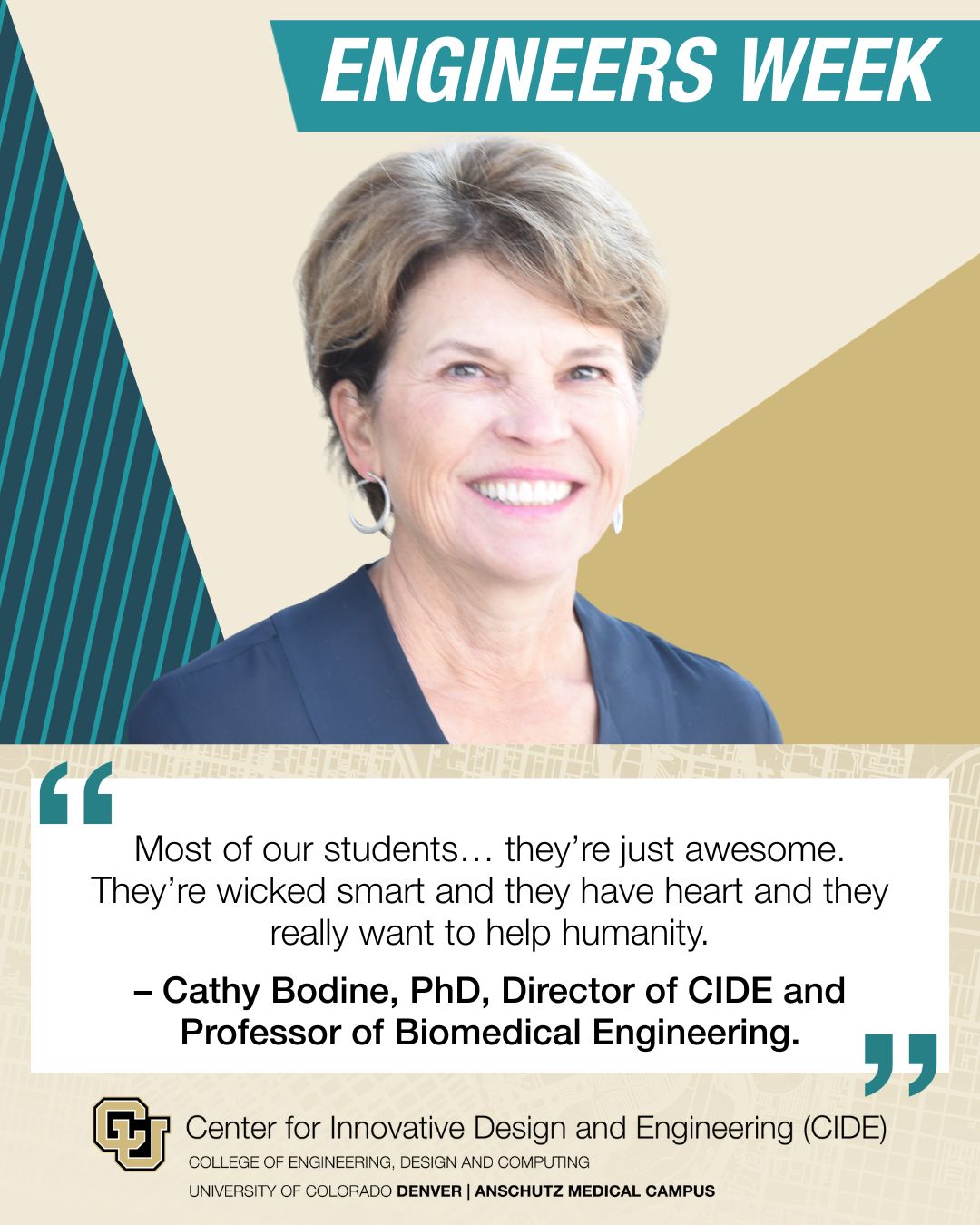
“Most of our students… they’re just awesome. They’re wicked smart and they have heart and they really want to help humanity.” Says Bodine.
Graduates move into roles with the Veterans Administration as rehabilitation engineers and into companies such as Amazon, Microsoft, and Medtronic, working in accessibility, human factors, and inclusive product development. But beyond titles and employers, the impact is clear, our students are reshaping the way technology serves humanity and shaping the innovation landscape.
A Lifespan Approach to Impact
CIDE often describes its philosophy as “womb to tomb,” a lifespan approach to accessibility. From infants leaving neonatal intensive care units to K–12 classrooms across Colorado, from college transitions to workforce participation and aging in place, accessibility touches every stage of life.
“Our goal has always been to make the world a better place and an easier place for people with disabilities to navigate,” says Bodine.
Accessibility is not about a single population. It is about all of us. We will all rely on accessible design at some point in our lives, whether temporarily or permanently. When engineering anticipates that reality, it strengthens the fabric of society itself.
The Future Is Being Built Here
Engineering transforms our collective future when it centers people. When it anticipates shifts in our needs instead of reacting to them. When it removes barriers before they calcify. When it treats independence as infrastructure.
The future of engineering is accessible. The future of innovation is human-centered.
And at the College of Engineering, Design and Computing at the University of Colorado Denver, that future is not a distant vision, it is already here. It is being designed in classrooms, tested in clinics, refined in research labs, and deployed in communities.
Categories
Discover more from College of Engineering, Design and Computing News
Subscribe to get the latest posts sent to your email.

CU Denver Engineering, Design and Computing View All
At the CU Denver College of Engineering, Design and Computing, we focus on providing our students with a comprehensive engineering education at the undergraduate, graduate and professional level. Faculty conduct research that spans our five disciplines of civil, electrical and mechanical engineering, bioengineering, and computer science and engineering. The college collaborates with industry from around the state; our laboratories and research opportunities give students the hands-on experience they need to excel in the professional world.
 College of Engineering, Design and Computing News