
Inside CU Denver’s Magnetic Materials Laboratory: Where Students Advance Electromagnetic Research
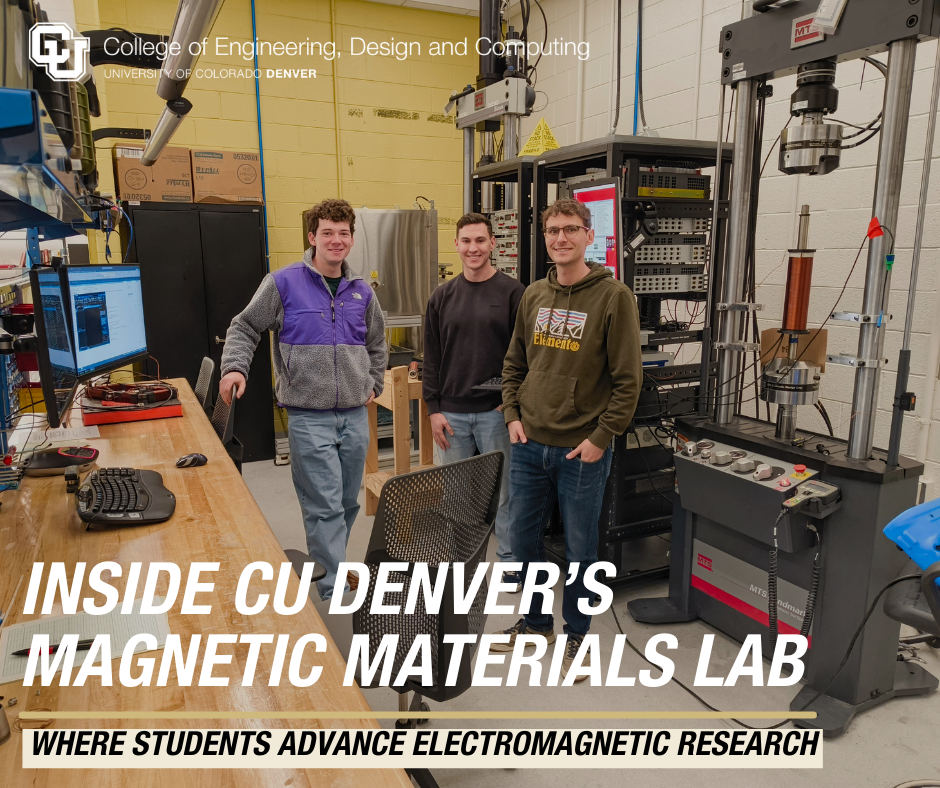
Deep inside the University of Colorado Denver’s College of Engineering, Design and Computing, students and researchers are working on a class of problems most people rarely think about, but that influence many modern technologies: how ferromagnetic materials behave. These materials—commonly found in steels and electrical components—play critical roles in systems ranging from electric power infrastructure to transportation and advanced sensing technologies.
The internal magnetic structure of ferromagnetic materials can respond in complex ways; these responses influence how efficiently electric motors and transformers operate, how structural components behave under load, and how engineers design systems that rely on magnetic materials for sensing, actuation, and transportation technologies.
In the Magnetic Materials Laboratory, led by CU Denver Distinguished Professor Stephen Gedney PhD., students help design measurement systems and computational models that allow engineers to understand and predict these behaviors. By carefully measuring how ferromagnetic materials respond to magnetic fields, mechanical stress, and thermal changes, researchers generate data that can be incorporated into advanced simulation tools used in engineering design.
These models allow engineers to simulate how large steel structures, electrical machines, and other engineered systems respond to real-world operating conditions, helping improve efficiency, reliability, and performance before physical systems are built.
“The overall mission of the CU Denver Magnetic Materials Laboratory is to provide the utilities, knowledge, physics, and simulation capabilities needed to predict how ferromagnetic materials behave in complex environments,” says Gedney. “These simulations capture the nonlinear and hysteretic behavior of such materials and predict how they respond to environmental stimuli, including variations in the ambient magnetic field, applied mechanical stresses, and temperature changes.”
While the team focuses on advanced measurements of ferromagnetic materials, the research also pushes deeper into the underlying physics; insights that feed directly into multiple areas of applied research, including sensing technologies and naval protection.
“In addition to that, we are always exploring the physics behind these properties, continually getting deeper insights in non-linear magneto-hysteretic, magneto-elastic and magneto-thermal properties of materials,” says Gedney. “Our research spans several application areas, including non-destructive testing and sensing, actuators, electromechanical devices, and next-generation sensing devices.”
The lab’s unique combination of measurement and digital modeling allows students and researchers to test, refine, and optimize designs before physically making them.
“By incorporating physics-based models that accurately represent the underlying magneto-mechanical interactions, these tools enable engineers to prototype and evaluate designs computationally before moving to physical implementation,” says Gedney. “We have built from the ground up a world-class measurement facility that is very unique, and we are one of only a few in the world that can perform the type of measurements that we do to the level of accuracy that we can achieve.”
In effect, the lab transforms complex physical phenomena into actionable engineering solutions, giving students the opportunity to see their work move from theory to tangible impact—whether in defense applications, advanced sensing, or cutting-edge electromechanical devices.
Real Research, Starting as an Undergraduate
More than a specialized research facility, the Magnetic Materials Laboratory is an immersive engineering environment where students play a central role in building, operating, and advancing the research.
“Students participate in all aspects of the laboratory,” Gedney explains. “All of the students who have worked in this lab have started out as undergraduate research assistants. All, have gone on to, or about to, complete their MS degree. All have been in our EE scholars program which allows them to overlap their BS and MS degree, such that they finish their MS in at most 1 year after the BS. Some have continued on for a PhD.”
That early access to hands-on research is significant. Rather than waiting until graduate school to engage with advanced engineering problems, CU Denver students begin contributing as undergraduates. By the time our students complete their degrees, they have already spent years working on complex engineering challenges, giving them experience that closely mirrors professional research and industry environments.
Inside the lab, students gain practical skills across multiple dimensions: designing experiments, writing control software, calibrating sensors, building test equipment, and analyzing experimental data.
“Students are asked to design and conduct various experiments on a daily basis, in order to characterize a multitude of properties of different ferromagnetic materials,” says Gedney. “Students are required to give at least one seminar semester on their research in the lab. This includes students at all levels—BS, MS or PhD,.
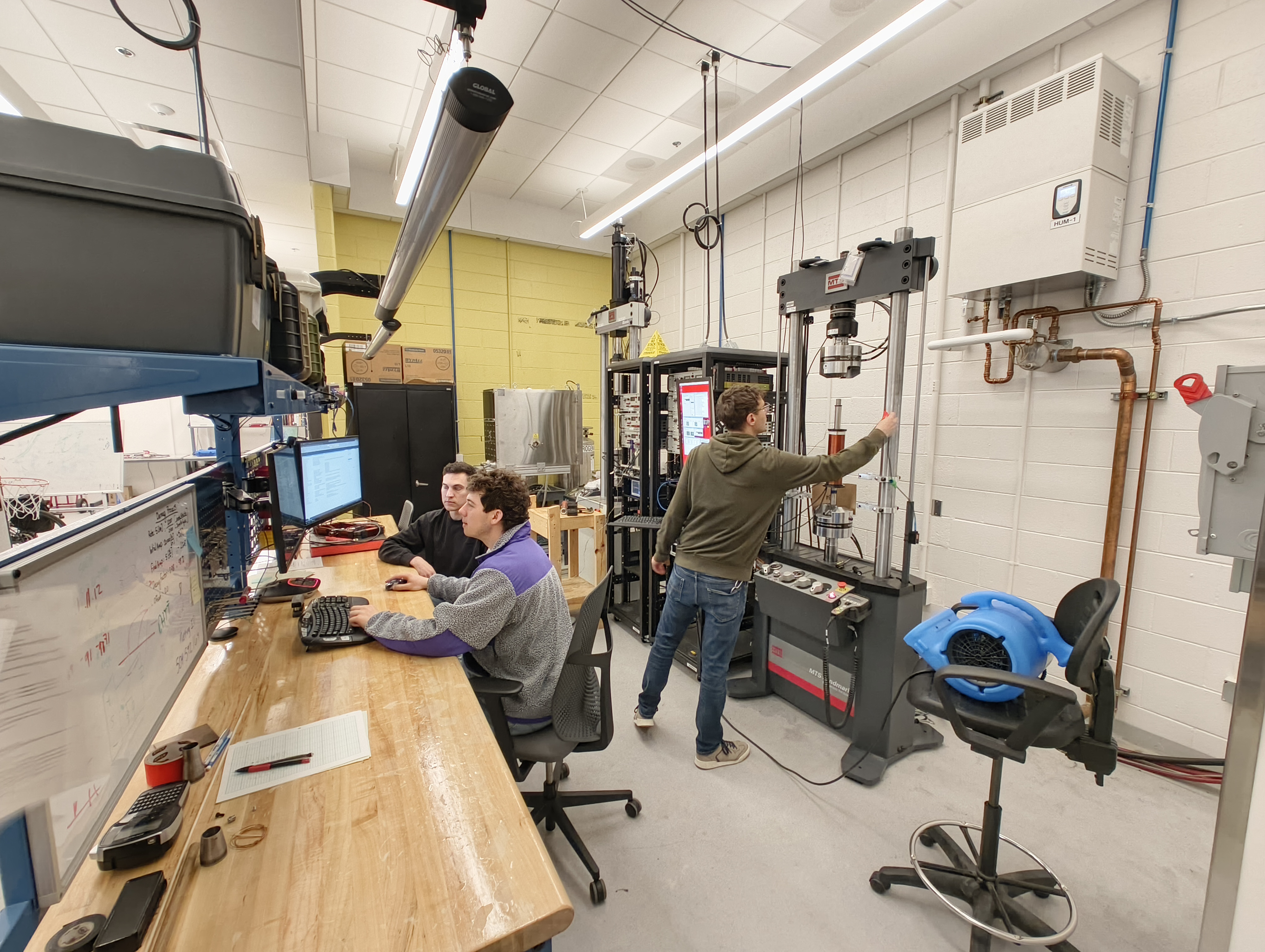
He adds, “We often interact with our clients, through which students get deeper insights into applications and properties of materials. They also are engaged in the discussions, which requires them to have a deeper knowledge.”
This hands-on, collaborative experience goes beyond preparing students for advanced engineering careers, it positions them to innovate. Because they are deeply involved in every aspect of the lab’s work, students often identify opportunities to improve processes, design new tools, and advance the research itself.
Student Driving Innovation
The Magnetic Materials Laboratory didn’t begin as a fully equipped facility. Much of the equipment needed for this research simply didn’t exist.
“We had to start from ground zero on assembling our lab,” Gedney explains. “This involved using equipment that was never intended for our purposes, so we had to work with the manufacturer to custom design each piece of equipment to retro-fit into our conceived design.”
Students played a key role in assembling the early systems, helping synchronize instruments, build hardware, and bring the lab’s first experiments online.
“I was able to hire two of our best EE students at the time, Sean Joyce and Todd Fulton, to work with me to assemble all the equipment properly, get all the pieces to synchronize properly, and work in cooperation,” says Gedney. “We were all learning together, and faced daily challenges, and new problems that we had to work through.”
Over time, these contributions have fundamentally shaped how the lab operates.
Student Mark Travers developed the foundation of the lab’s MagLabUtilities software, which allows researchers to automate and coordinate multiple instruments during experiments.
“Previously, we relied on an industry standard control software called LabView, which was developed by National Instruments, to conduct a new type of experiment that used to take days to weeks to successfully setup,” says Gedney. “With MagLabUtilities, we can setup a new type of experiment in minutes, giving us great flexibility. We can now generate 10x more data in days, which used to take us weeks to accomplish.”
By taking ownership of real engineering problems, students are not merely assisting, they are identifying challenges, designing solutions, and improving the lab’s capabilities in meaningful ways. Their contributions often address practical issues, but these solutions work to push the boundaries of what the lab can study.
“Students Joseph Gedney and Isabella Gomez developed a new type of Faraday Coil for measuring the magnetization,” says Gedney. “This insight dramatically reduced noise in our measurements by an order of magnitude, allowing us to make measurements at very low field levels.”
Students have even helped redesign the physical infrastructure of the lab. “Kyle Redmond designed and constructed equipment racks that house all of our equipment, so now our apparatus is compactly located, modularized, and easily access and maintainable (and it looks professional!),” says Gedney.
For Gedney, this student-driven innovation is one of the defining characteristics of the lab.
“These are a few examples. I could give several more,” says Gedney. “What I can say is that every student that has come through the lab has contributed a unique facet to the laboratory in an impactful way.”
Preparing the Next Generation of Engineers
Graduates leave the lab with hands-on experience in electromagnetic theory, advanced modeling, and precision measurement—skills that translate directly into careers across communications, sensing technologies, national defense, and advanced electronic systems.
For many students, the experience gained in the Magnetic Materials Laboratory provides a pathway into these high-demand fields, giving them the hands-on research and technical expertise that employers are actively seeking. Alumni have gone on to positions at organizations such as Lockheed Martin, Raytheon, Analog Devices, Seagate Technology, and BAE Systems.
The lab’s focus on electromagnetics and radio-frequency (RF) systems aligns with a growing workforce need in these specialized areas of electrical engineering.
“At this point in time, there are a lot of jobs in the RF area in the both the defense and public sectors,” says Gedney. “There is a significant need for good engineers in this area. Not just in the area of defense, but also in the public communications sector, as well as in the high speed digital electronics.”
By preparing students to fill this critical gap, the lab not only equips them with in-demand skills but also ensures that their work contributes to technologies that serve society and advance the field of engineering as a whole.
For Gedney, the achievements of his students reflect the broader purpose of engineering: “Engineers are individuals who love to solve problems,” he says. “They are applied mathematicians and physicists (and sometimes chemists) who take fundamental principles of math and science to design things for the betterment of society.”
With advanced research, custom-built technology, and deep student involvement, the lab demonstrates how applied learning at CU Denver prepares graduates to do just that.
From Classroom to Lab to Career
Be part of research that matters. Join CU Denver’s Electrical Engineering program and gain hands-on experience in the Magnetic Materials Laboratory—design experiments, develop advanced technologies, and contribute to complex projects that advance engineering.
Categories
Electrical Engineering, Faculty, News, Research Opportunities
Discover more from College of Engineering, Design and Computing News
Subscribe to get the latest posts sent to your email.

CU Denver Engineering, Design and Computing View All
At the CU Denver College of Engineering, Design and Computing, we focus on providing our students with a comprehensive engineering education at the undergraduate, graduate and professional level. Faculty conduct research that spans our five disciplines of civil, electrical and mechanical engineering, bioengineering, and computer science and engineering. The college collaborates with industry from around the state; our laboratories and research opportunities give students the hands-on experience they need to excel in the professional world.
 College of Engineering, Design and Computing News