
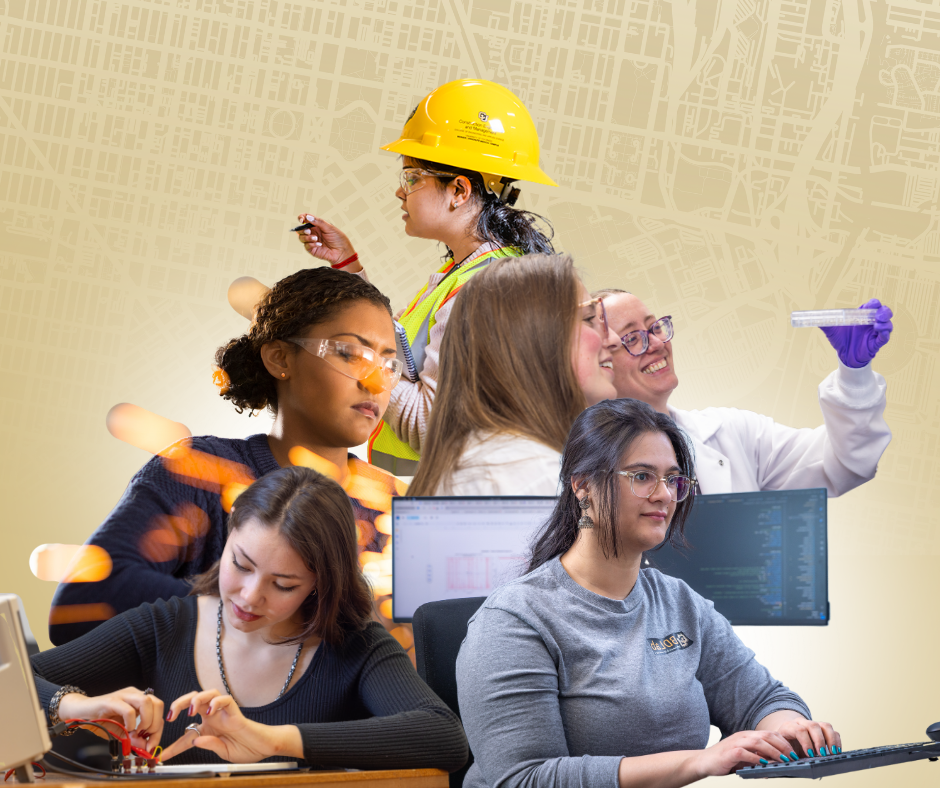
On Women’s Equality Day, CU Denver celebrates women faculty who are expanding what engineering can look like and helping the next generations see themselves in it.
When Kristyn Masters was 9 years old, she learned an early lesson about who was expected to become an engineer.
Girls, a summer camp director told her, were not allowed to enroll in a rocketry elective. It was an early lesson in who, according to someone else, was supposed to become an engineer. But it wasn’t the last word.
Years later, a professor saw something different. Without telling Masters, the professor nominated her for a scholarship that required working in a research lab. The experience changed the trajectory of her career.
“The defining moment for me was when one of my professors nominated me (without me knowing) for a scholarship that required me to work in a research lab, and I found working in a lab to be life-changing,” Masters said. “I immediately realized that I absolutely loved research.”
Today, Masters is a professor and chair of the Department of Biomedical Engineering at CU Denver’s College of Engineering, Design and Computing.
Her story points to a larger truth for women considering engineering and computing: Belonging often begins when you are presented with the opportunity to meet the moment.
At CU Denver, that opportunity can begin with a faculty mentor who invites you into a research lab, a professor who encourages your ideas, a classmate who recognizes your strengths or a community that helps you see yourself as an engineer.
For Masters, Assistant Professor in Mechanical Engineering Linyue Gao, and Assistant Professor in Civil Engineering and Construction Aditi Misra, creating that sense of belonging is about strengthening the field by ensuring that more people can contribute their perspectives, pursue their ideas and shape the future of engineering.
The path to becoming an engineer
There is no single way to become an engineer.
For Masters, the path began in science and was nearly discouraged. For Assistant Professor Linyue Gao her path into engineering grew at the intersection of making things and art. Her grandfather, a civil engineer who made toys for her, introduced her to problem-solving. Later, fluid mechanics showed her that creativity and technical rigor could exist in the same career.
“What helped me see a place for myself was realizing that engineering does not have to follow one traditional path,” Gao said. “I hope young women see that there is no single way to be an engineer. You can cross disciplines, follow your curiosity, bring your whole self to your work, and create a path that is uniquely your own.”
Similarly, when Assistant Professor Aditi Misra found her path into engineering, it was through looking at mathematics with a new perspective. Her father taught her to approach math as a puzzle rather than something intimidating. Female math teachers reinforced the idea that technical fields were places where she belonged, which made engineering feel like a natural path for her.
“When I proved to be a strong coder and classmates regularly turned to me for help, working in a field traditionally dominated by men simply felt normal,” Misra said.
Now she wants her students to experience that same sense of possibility.

“I hope my students take away the same message when they see me and the other women at CEDC: that they belong here, and that no career is out of reach.”
That message matters because representation is more than seeing someone who looks like you at the front of a classroom.
It can change what you imagine for yourself. And sometimes, that one opportunity can change everything.
Find the people who will help you grow
Masters knows the power of a supportive mentoring community firsthand.
Throughout her career, she has built what she describes as a “village” of women who support one another’s work and careers.
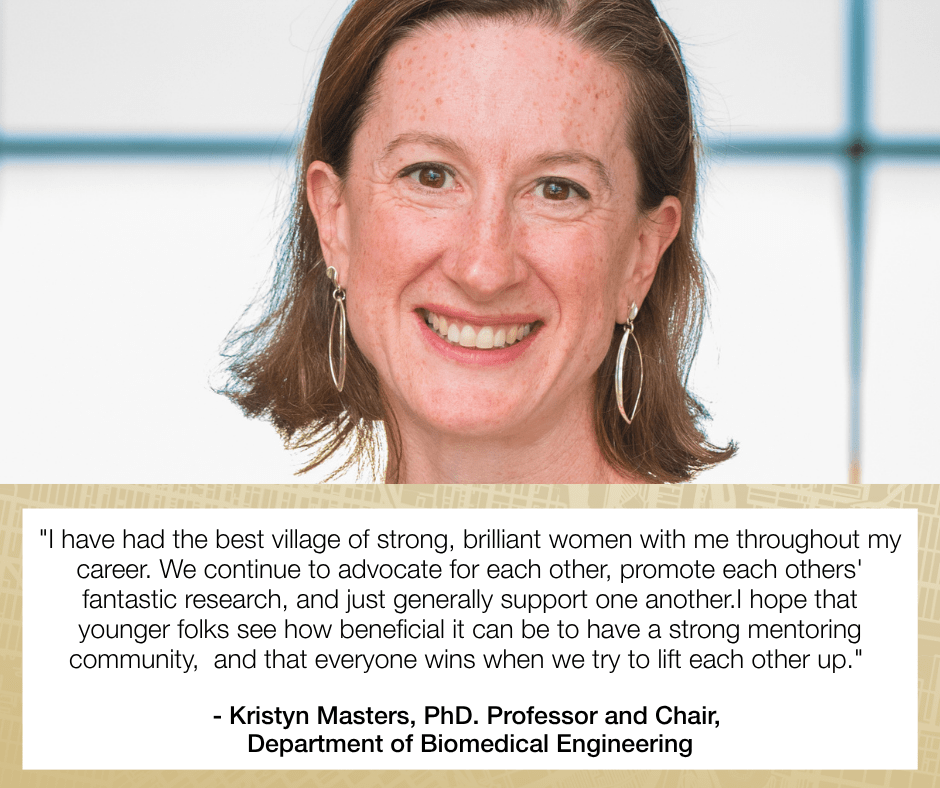
“I have had the best village of strong, brilliant women with me throughout my career,” Masters said. “We continue to advocate for each other, promote each others’ fantastic research, and just generally support one another.”
That is the kind of community she hopes younger women will build, too.
“I hope that younger folks see how beneficial it can be to have a strong mentoring community, and that everyone wins when we try to lift each other up.”
At CEDC, mentorship can take many forms.
Gao has mentored doctoral students, more than 10 CU Denver undergraduates and community college interns through her research. She has also brought the work of her wind tunnel laboratory into undergraduate fluid mechanics education, giving students the opportunity to encounter advanced research as part of their education.
Misra has helped create opportunities for students to take their research beyond campus. Through the local Dwight D. Eisenhower Transportation Fellowship competition at CU Denver, four students received funding to present their work at the Transportation Research Board Annual Meeting, an international gathering of transportation researchers and professionals.
“I’m really happy about the steps our department has been taking to make our courses and degree/certificate programs more accessible, so that a broad range of learners can experience biomedical engineering!” says Masters. “We are continuing to expand those efforts, to help as many people as possible see themselves as future biomedical engineers.”
These experiences do more than strengthen a résumé.
They tell students: Your ideas belong in this conversation by giving them the space to contribute.
More voices make engineering stronger
For these faculty members, increasing women’s representation in engineering isn’t simply about numbers.
It changes the questions engineers ask, the problems they notice and the solutions they build.
Gao sees today’s engineering challenges as increasingly interconnected, spanning technology, energy, climate and society.
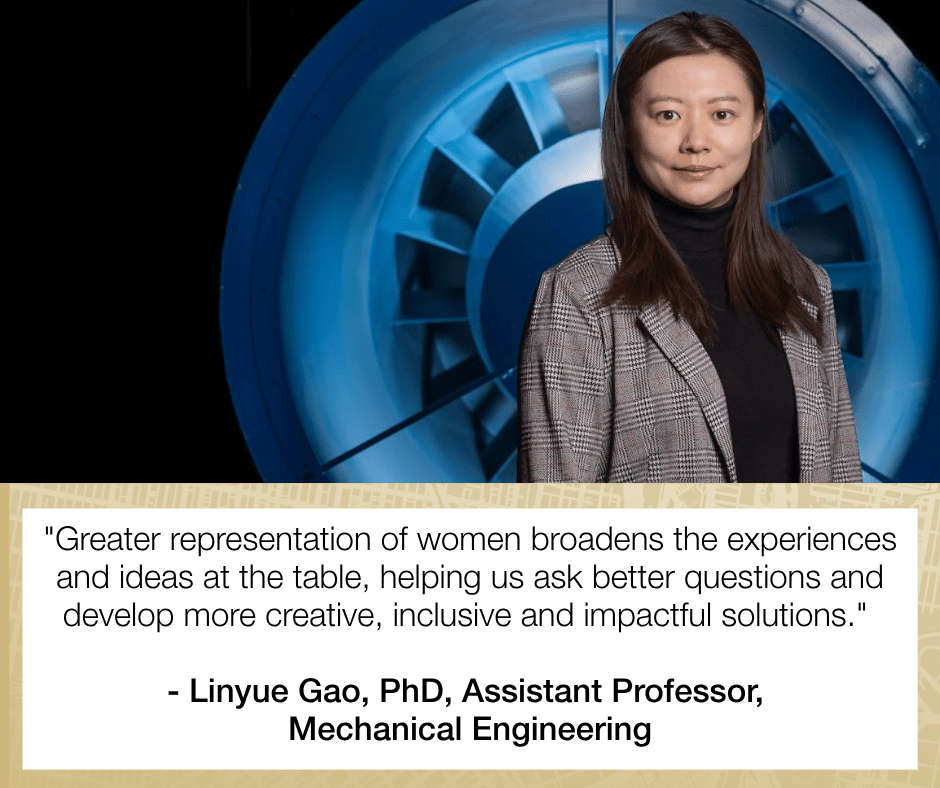
“Greater representation of women broadens the experiences and ideas at the table,” Gao said, “helping us ask better questions and develop more creative, inclusive and impactful solutions.”
Masters has seen that evolution in her own research.
Her laboratory investigates why men and women can experience different symptoms and disease trajectories. Understanding those differences could lead to more accurate approaches to diagnosis and treatment and ultimately improve women’s health.
She has also watched women’s health research become more prominent as more women have entered the field.
“I’ve seen my own research field — which investigates sex differences in diseases, as well as other topics related to women’s health — become much more prominent with the addition of more women researchers over the last decade or so,” Masters said. “Our major conferences and professional societies now routinely have ‘women’s health’ divisions, which was simply not the case just a few years ago,”
For Misra, the value of representation comes from taking a broader view of the problems engineers are asked to solve.
“In my experience, women tend to approach problems as systems thinkers,” Misra said. “We produce solutions that are more holistic, attentive to the end user, to society and to broader consequences, rather than focused solely on the novelty of the technology.”
That perspective is increasingly important as engineering problems become more complex. The more perspectives engineers bring to that work, the more possibilities there are for understanding the problem — and solving it well.
Your path doesn’t have to look like anyone else’s
All three careers demonstrate what becomes possible when more people have the opportunity to participate in engineering and computing.
More perspectives enter classrooms and laboratories. Different questions get asked. Students gain more examples of what technical careers can look like. And the systems, technologies and solutions that emerge can better reflect the people they are meant to serve.
That is the opportunity waiting for the next generation of engineers.
Your path can start with a question you can’t stop thinking about, a natural knack for math, or an opportunity from a professor who has seen something in you that you haven’t yet. You just need the chance to explore it in a community that believes your ideas are worth developing.
That is the kind of future these women are helping build at CU Denver: one where students can see themselves in engineering, find people who will support them and discover what they are capable of contributing.
Because engineering your perspective, your curiosity and the ideas only you can bring to the work.
Interested in engineering, computing or STEM but still figuring out where you fit?
Explore the College of Engineering, Design and Computing at CU Denver, meet faculty working across fields from biomedical engineering and renewable energy to computing, infrastructure and accessible technology, and discover opportunities to participate in research, build professional connections and find mentors who can help turn your interests into a career.
Leave a Reply