

At AI 4 Infrastructure (AI4I), CU Denver students tackled real-world challenges brought by industry partners, demonstrating how artificial intelligence could change the way cities maintain infrastructure, manage resources and serve their communities.
A pothole goes unreported until it damages a car. A bridge develops structural problems that go undetected until repairs become costly. A visitor enters a public building and struggles to find an accessible route to their destination.
Cities receive reports of infrastructure problems through phone calls, emails and other channels, often with limited staff, time and budgets to address them. For engineers responsible for maintaining these systems, the challenge is increasingly about identifying problems before they escalate, anticipating maintenance needs and making informed decisions about where limited resources will have the greatest impact.
At the University of Colorado Denver’s College of Engineering, Design and Computing (CEDC), students are exploring how artificial intelligence can help solve those challenges.
That work was on display at AI for Infrastructure (AI4I), the second annual Infrastructure Workforce Forum, convened by the Colorado Smart Cities Alliance with industry and higher education partners. Held at Trimble last year, the forum adopted an AI theme this year and is planned to continue annually. It brought together students, faculty, government representatives and industry professionals for panels, lightning talks, demonstrations, a keynote, networking and a two-track student competition exploring how AI is changing the way infrastructure is designed, operated and maintained.
Through student competitions built around challenges brought directly by industry partners, CU Denver students put emerging technology to work on problems facing cities and public agencies. The event also connected their work to a broader conversation about the future of infrastructure and the engineering skills needed to build it.
For CU Denver, the opportunity extends beyond developing new technologies. It means preparing engineers who can apply AI to complex problems, collaborate across disciplines and understand the people and communities their solutions will serve.
Real Infrastructure Problems, Student-Driven AI Solutions
For Farnoush Banaei-Kashani, one of the most compelling parts of AI 4 Infrastructure was seeing how students approached problems that engineers encounter every day.
Both student competition challenges came directly from industry partners and centered on a problem familiar to city governments: managing public infrastructure complaints.
A city might receive reports of flooding, damaged sidewalks, and other concerns through hundreds of different communications. Each report must be reviewed, assessed and prioritized before an engineering team can determine what action is needed.
For departments operating with limited staff and resources, sorting through that information can consume valuable time that could otherwise be spent addressing the problems themselves.
“How do you process that?” Banaei-Kashani asked. “You can use AI to kind of sift through that information, categorize them, prioritize them, assess their validity.”
Using synthetic data modeled on real-world conditions, students were challenged to develop AI-based tools that could help engineers evaluate incoming reports, identify urgent concerns and make more informed decisions about dispatching maintenance crews.
A second, advanced track focused on using AI and LiDAR data to map infrastructure.

The challenge was an opportunity to apply emerging technology to a problem identified by the professionals responsible for managing infrastructure.
It also revealed something Banaei-Kashani hadn’t fully anticipated.
Students from mechanical engineering, electrical engineering and computer science approached the same challenge with different ideas, drawing on the methods and technologies familiar to their respective disciplines.
“Each of them came from their own perspective to this,” Banaei-Kashani said. “I love the way they think anew. And creatively, based on the tools that they have handy available to them.”
The diversity of approaches demonstrated the value of bringing engineering and computing students together around a shared problem.
It also reflected how infrastructure challenges are solved outside the university, where engineers, technology specialists and public agencies must combine their expertise to develop solutions that work in practice.
For Banaei-Kashani, the experience opened possibilities for future interdisciplinary capstone projects and industry-connected programming at CEDC.
“That’s the environment they’re going to work in anyway,” he said.
AI Is Already Changing How Engineers Think About Infrastructure
The challenges students explored at AI 4 Infrastructure are closely connected to research already underway at CU Denver.
Banaei-Kashani began investigating the intersection of artificial intelligence and infrastructure around 2016 through a collaboration with civil engineering professor Kevin Rens.
That work helped establish CU Denver’s Infrastructure Informatics initiative, the university’s first chancellor-funded Grand Challenge project. The initiative supported 12 research teams working across six types of infrastructure, exploring how AI could improve infrastructure design, maintenance and management.
Nearly a decade later, those questions have become increasingly relevant as AI tools grow more capable.
One of the most immediate applications is predictive maintenance, using data to identify infrastructure problems before they become emergencies.
“Instead of emergency maintenance, we do preventive maintenance using predictive analytics and AI,” Banaei-Kashani said.
He compares the approach to preventive health care. Just as regular medical checkups can help identify problems before they become serious, AI can help engineers detect infrastructure defects, predict how conditions may change and determine where maintenance resources should be directed.
The applications extend across bridges, culverts, pavements and sidewalks, where early detection and more efficient planning could help municipalities manage infrastructure with limited budgets.
Making Infrastructure Work Better for People
For CU Denver student Manali Raut, the future of AI-enabled infrastructure is about more than maintaining our infrastructure, it is also about improving how people interact with the spaces around them.
“AI for infrastructure means using AI to make environments easier to build, navigate, operate, and access,” Raut said.
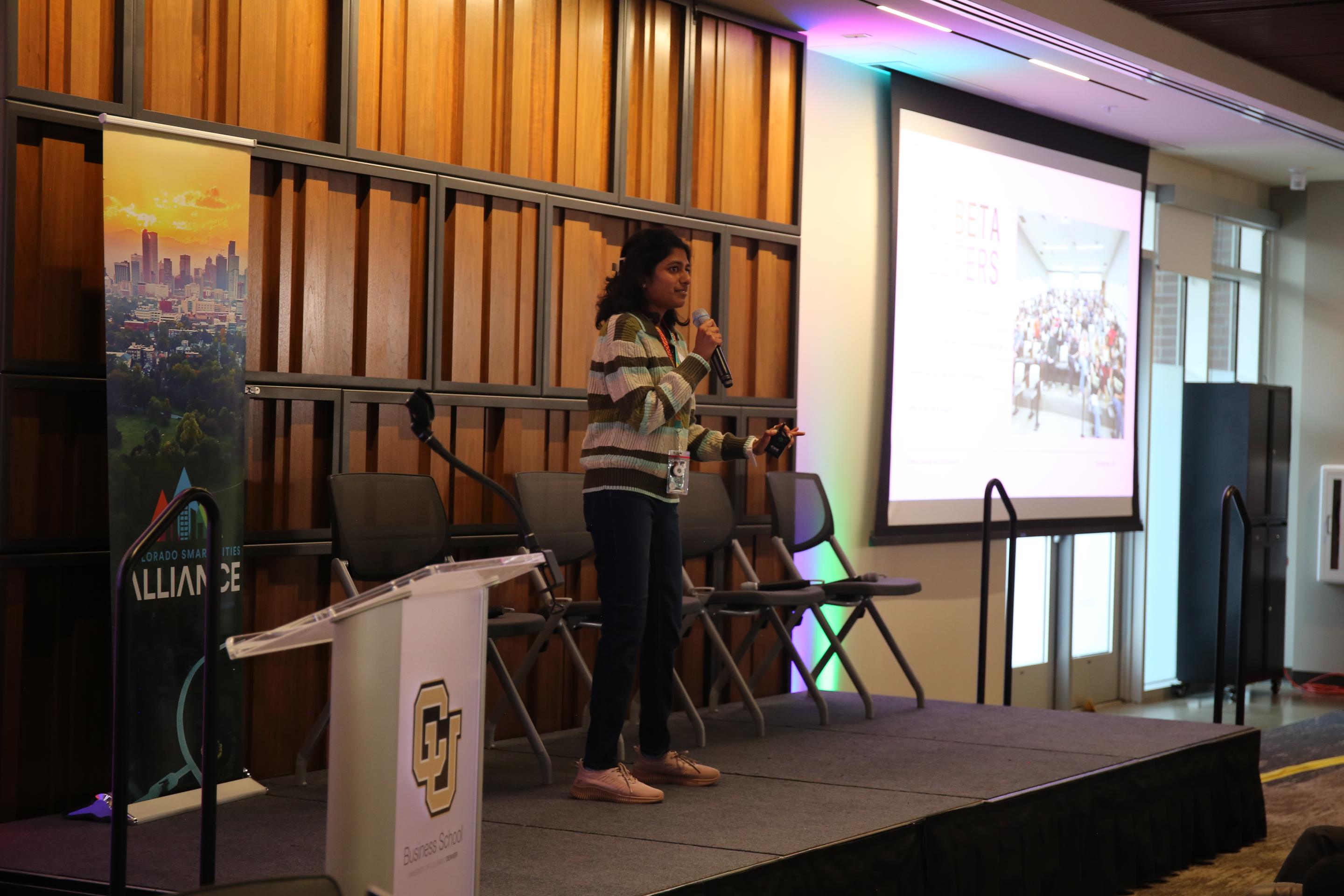
Her work on GlyphGuide, an indoor navigation platform, explores how augmented reality and artificial intelligence could help people move more effectively through complex buildings.
The project collects data about how people navigate indoor environments, including where they successfully find their destinations, become confused or take inefficient routes.
“The environment generates data, AI learns from that data, and the insights can then improve how people navigate the environment,” Raut said.
The project illustrates how AI could help engineers understand infrastructure from the perspective of the people using it. For example, an indoor navigation system may identify an efficient route through a government building. But designing a system that works for people with different mobility needs, levels of familiarity and accessibility requirements demands more than computing the shortest path.
Raut believes effective AI-enabled infrastructure requires expertise from engineering, architecture, transportation, sociology, accessibility and civic systems.
That interdisciplinary perspective closely mirrors what students experienced during the AI 4 Infrastructure competitions, where different technical backgrounds produced different approaches to the same challenge.
“AI is most effective when combined with human expertise and oversight,”she said. “AI can generate answers, but humans still need to understand the context and decide what should actually be done.”
She also cautioned that the quality of AI-generated recommendations depends on the information and processes behind them.
“AI is a mirror to bad processes or bad data,” Raut said. “If the underlying process is poorly designed or the data is unreliable, AI doesn’t automatically correct that problem.”
Those insights point to an important distinction for future engineers: learning to use AI is only part of the challenge. Understanding when to trust it, how to evaluate its recommendations and whether its solutions serve the people affected by them is equally important. That relationship between technical capability and human judgment became a recurring theme throughout AI 4 Infrastructure.
Preparing Students for the Next Generation of Engineering Careers
For Banaei-Kashani, the student competitions demonstrated the kind of experience that will become increasingly important as AI changes engineering practice.
He believes students need three interconnected capabilities to succeed in an AI-enabled workforce: an understanding of AI technologies, the practical skills to use them, and experience applying those tools to real problems.
“We don’t want people to know concepts only. That’s not useful,” he said. “We want them to be able to, you know, pull up their sleeves and start working and putting AI to work in particular problems.”
That final step is especially important.
Students may learn how an AI model works in a controlled classroom environment, but applying that knowledge to infrastructure introduces new challenges involving incomplete information, competing priorities, and decisions that affect public resources.
Industry-sponsored competitions create opportunities to navigate those challenges while students are still developing their expertise.
Banaei-Kashani said industry colleagues have also emphasized the importance of bringing AI-fluent graduates into engineering teams, where they can contribute emerging technical skills alongside experienced professionals with deep knowledge of infrastructure systems.
That combination could help organizations integrate AI into existing engineering practices while creating new opportunities for graduates to contribute early in their careers.
The AI 4 Infrastructure event gave students experience with that intersection of technical knowledge and professional practice.
Members of CU Denver’s AI Student Association (AISA) helped organize the competitions, coordinating preparatory webinars, hackathon sessions, judging and presentations by winning teams. Their involvement extended beyond developing AI solutions, with students creating and managing programming that connected their peers with faculty, industry representatives and real engineering challenges.
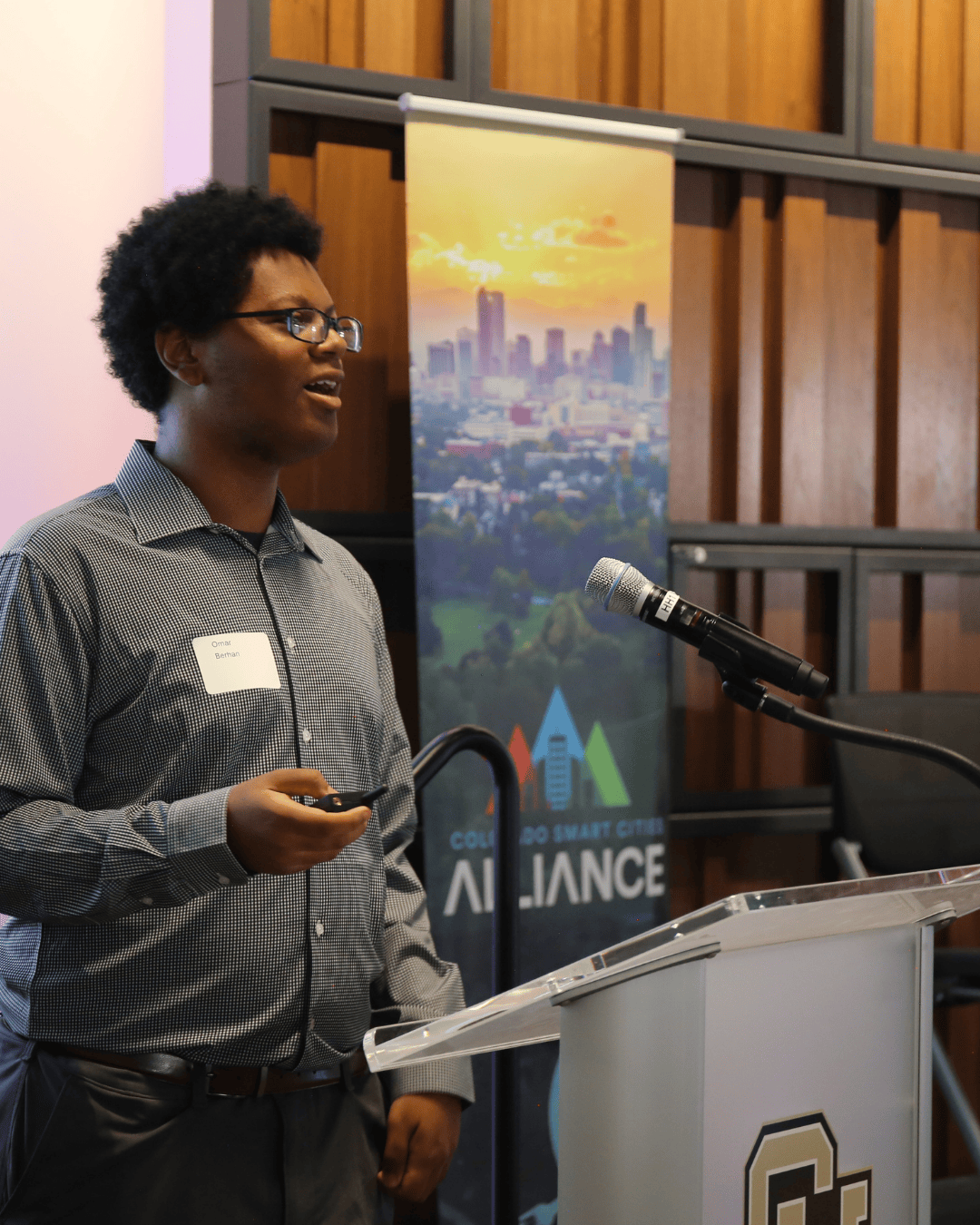
For Banaei-Kashani, the student engagement was one of the event’s defining outcomes.
It demonstrated what can happen when students are given opportunities to take ownership of ambitious work and collaborate across disciplines.
Connecting CU Denver to Colorado’s Infrastructure Future
The event also highlighted the importance of connecting academic research with the people and organizations responsible for maintaining Colorado’s infrastructure.
Banaei-Kashani pointed to the Colorado Smart Cities Alliance as an important part of that ecosystem, helping build relationships between academia, industry and government.
Those connections create opportunities for researchers and students to better understand the challenges facing public agencies and explore how emerging technologies could address them.
For infrastructure engineering, that relationship is especially important. A promising technical solution must ultimately work within the budgets, operational requirements and public responsibilities of the organizations implementing it.
Banaei-Kashani also highlighted conversations with leaders from the local government and industry about the potential applications of AI.
For Raut, Denver offers a setting where technology and infrastructure challenges intersect in ways that are relevant to both research and public life.
“Denver is interesting because it provides an environment where technology intersects with real infrastructure challenges — transportation, public spaces, accessibility, energy, and growing urban environments,” she said.
That proximity creates opportunities for CU Denver students to investigate problems connected to the city around them while building relationships with the professionals and organizations shaping Colorado’s infrastructure.
AI 4 Infrastructure brought those connections into one conversation, linking faculty research, student-led problem-solving and industry needs around a shared question: How can AI help engineers build and maintain infrastructure more effectively?
Building What’s Next
For Banaei-Kashani, the enthusiasm surrounding AI 4 Infrastructure reinforced the value of bringing students, researchers and industry professionals together to explore questions that no single discipline can solve alone.
For Raut, the event reinforced the importance of keeping human judgment at the center of increasingly intelligent systems.
“AI may increasingly handle more of the what, but humans still need to control the how and, most importantly, the why,” she said. That distinction captures the challenge facing the next generation of engineers.
Artificial intelligence may help cities identify problems earlier, make better use of maintenance resources and design more accessible public spaces. But turning those capabilities into reliable infrastructure solutions requires engineers who understand the technology, the systems it supports, and the communities it serves.
At CU Denver’s College of Engineering, Design and Computing, students are already developing that expertise through research, interdisciplinary collaboration and challenges brought directly by industry.
AI 4 Infrastructure offered a look at what that preparation can make possible: students working on real problems, faculty connecting emerging technologies with decades of infrastructure research, and industry partners helping define the questions that matter.
The next generation of infrastructure will be shaped by the engineers who know how to put these tools to work. At CU Denver, students are already learning to do exactly that.
Explore engineering and AI at CU Denver.
Leave a Reply