
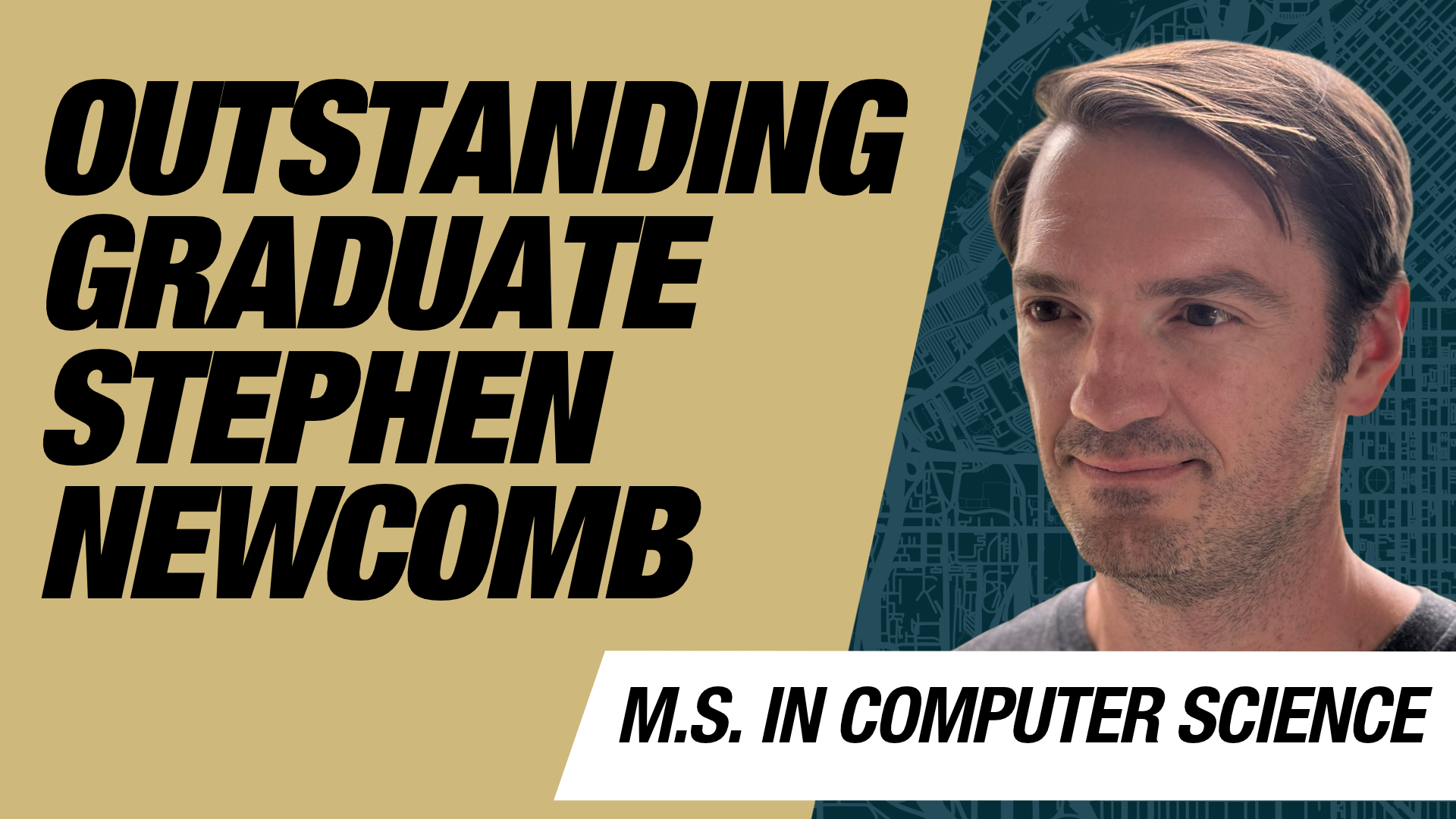
At CU Denver, soon-to-be computer science graduate turned years of healthcare experience into an AI platform now helping medical professionals make sense of complex data.
For years, Stephen Newcomb watched healthcare professionals struggle to answer questions using information their organizations already had.
The data existed. The challenge was connecting it across systems, analyzing it and turning it into actionable answers.
“Before enrolling in this program, I spent years in healthcare administration watching answers sit buried in data we already had,” Stephen Newcomb said. “The information was always there, but we simply could not reach it fast enough or string it together to form a confident solution.”
Newcomb knew the problem firsthand. What he needed were the technical skills to solve it.
He enrolled in the Master of Science in Computer Science program at the University of Colorado Denver, bringing years of healthcare administration experience and an ambitious goal: to develop technology that could make complex healthcare data more accessible, predictive and prescriptive.
What followed exceeded even his expectations.
Through advanced coursework, applied research and faculty mentorship at CU Denver’s College of Engineering, Design and Computing (CEDC), Newcomb developed the expertise to build NUCLEUS, an artificial intelligence platform that connects information across healthcare organizations and helps users analyze complex data and offers prescriptive solutions.
Today, NUCLEUS is in use at the CU Anschutz Medical Campus, where administrators and physicians have been granted access to the system.
As Newcomb prepares to graduate this December, the project represents his proudest accomplishment and a powerful example of what can happen when professional experience meets the opportunity to develop new technical expertise.
From Healthcare Experience to Real-World Solutions
NUCLEUS began as an idea to make information scattered across healthcare organizations easier to access.
Newcomb developed a multi-agent large language model (LLM) system that operates entirely on a secure organizational server. Through a dedicated data integration process, the platform brings together information from multiple organizations and allows authorized users to explore it through a natural-language interface.
What started as a way to ask questions across datasets evolved into a sophisticated analytical platform capable of generating reports, creating interactive dashboards and guiding users through complex, multidimensional questions while respecting their data permissions.
The result is a tool designed to help healthcare professionals move from fragmented information to actionable insights.
“NUCLEUS nearly resolves this issue with its ability to stretch across datasets from multiple organizations and develop real, prescriptive insights in mere seconds,” Newcomb said.
For Newcomb, the most meaningful part of the project isn’t simply its technical complexity. It’s that the system addresses the same challenges he encountered throughout his healthcare career.
And it has moved beyond the classroom.
NUCLEUS has been implemented at the CU Anschutz Medical Campus, giving administrators and physicians access to capabilities developed through his graduate work.
The project reflects the value of CU Denver’s approach to graduate education: connecting advanced computer science with students’ professional knowledge and providing opportunities to apply new skills to problems they understand firsthand.
Newcomb came to the program hoping to understand the systems he worked with every day. He left having built an intelligent system that unites them.
Finding Confidence Through Community
Newcomb entered CU Denver with professional experience, a clear sense of purpose and ambitious goals. But returning to the classroom also brought uncertainty. He understood healthcare systems. Learning to engineer the technology that could improve them was a different challenge.
Faculty, staff and classmates helped him navigate that transition. Among the people who made a lasting impression was Kelly Konrad, an administrator in the Department of Computer Science.
“Kelly Konrad, the CS administrator, believed in me,” Newcomb said. “Like many students, I felt the imposter syndrome, and I can still remember the mix of emotions walking into her office and staring down the massive course load standing between me and this degree.”
That encouragement mattered as Newcomb worked through demanding coursework and developed confidence in his abilities.
Faculty mentorship was equally important.
Newcomb credits Farnoush Banaei-Kashani, PhD, with teaching him how to develop intelligent computing systems through courses in data science and generative AI and with providing guidance as his graduate adviser.
His classmates also became an essential part of his experience.
“Classmates supported me! I made lasting friendships throughout the program, and those connections are what carried me through the hardest material and the toughest academic stretches.”
Together, those relationships gave Newcomb a supportive academic community in which to pursue increasingly complex work.
For a graduate student transitioning from healthcare administration into computer science, that combination of encouragement, technical instruction and mentorship helped turn a distant dream into something bigger than he had imagined.
Learning to Think Differently
Although Newcomb’s graduate project focused on applied AI, one of his most influential experiences came from a theoretical computer science course. In Tom Altman’s Theory of Automata class, students worked collaboratively to explore fundamental problems about what computers can and cannot compute.
The discussions challenged Newcomb to think beyond programming languages, algorithms and hardware. “More importantly, I feel like I (finally) began to grasp the very, fundamental nature of computing,” he said.
The course expanded his understanding of the discipline and prompted him to consider the broader implications of computation.
“Since we humans are, in our own way, instruction-execution experts, understanding these limitations turned into something much bigger than a simple computer science question. It became a new perspective on the very nature of humanity.”
That intellectual curiosity carried into his applied projects. Beyond NUCLEUS, Newcomb built a neural network analyzing live clinical revenue data, a reinforcement learning scheduler, a mobile application and a self-driving remote-controlled car.
Together, those experiences helped him develop a broader understanding of computing and the confidence to approach unfamiliar technical challenges.
“Considered holistically, CEDC didn’t just grant me a new set of skills,” Newcomb said. “It gave me a new perspective and a large dose of confidence to face ANY future challenge (… as long as it involves a computer).”
The Courage to Ask Anyway
As Newcomb prepares to graduate, his advice to future computer science students is simple. “Be the student you want to teach, one with insatiable curiosity and a healthy dose of courage,” Newcomb said.
He remembers what it feels like to sit in a classroom surrounded by people who seem more knowledgeable or more prepared. But his experience taught him that curiosity and the willingness to ask questions matter more than having every answer.
His own journey demonstrates what that curiosity can lead to.
Newcomb arrived at CU Denver with years of healthcare experience and a problem he wanted to solve. This December, he will graduate with advanced technical expertise, lasting professional relationships and an AI platform already in use at a major academic medical campus.
He also leaves with something he hadn’t fully anticipated: the confidence to approach problems far beyond the one that first inspired him to pursue computer science.
His experience reflects the opportunities available through CU Denver’s graduate programs, where students can build on their professional backgrounds, learn from faculty with specialized expertise and apply advanced computing skills to challenges across industries.
For Newcomb, the greatest lesson may be that meaningful progress begins with curiosity and the courage to pursue an answer.
As he reminds future students, even when uncertainty makes it tempting to remain silent, gather your resolve “… and ask anyway.”
Put Your Ideas to Work at CU Denver
CU Denver’s graduate computer science programs connect advanced computing, artificial intelligence and applied research with opportunities to address challenges across industries.
Leave a Reply