
What if you could do more than just design a part, but fully program how it moves, adapts, and performs?
In labs where robotics, materials science, and advanced manufacturing intersect, CU Denver students are helping redefine what engineering can do, working alongside faculty to push beyond traditional limits and create smarter, more adaptive, and more sustainable systems.
At the center of this momentum is Associate Professor of Mechanical Engineering Kai Yu PhD., whose work in robotic additive manufacturing is redefining what materials can do. The result is work that is not only advancing the field, but creating a hands-on, high-impact learning environment that sets CU Denver apart.
Expanding the Limits of 3D Printing
For more than a decade, additive manufacturing has transformed industries ranging from aerospace to healthcare. However, most systems still rely on simple, layer-by-layer fabrication methods that constrain design freedom.
Yu’s interest in the field began with a fundamental question: how can manufacturing move beyond rigid, layer-by-layer processes?
“What initially drew me to robotic additive manufacturing was the extraordinary level of control and manufacturing freedom that a robotic arm can provide,” says Kai Yu. “Over time, my journey in this field has evolved from an interest in greater manufacturing freedom to a broader effort to engineer materials, structures, and functions in ways that were previously very difficult or even impossible.”
With support from the Air Force Office of Scientific Research through the Mechanics of Multifunctional Materials and Microsystems program, the team introduced a six-axis industrial robotic arm into their lab enabling a shift from planar printing to fully three-dimensional material placement.
“The grant allowed us to purchase an industrial-grade six-axis robot, which launched our journey in robotic additive manufacturing,” Yu said.
Using robotic systems, Yu’s lab can now fabricate continuous fiber-reinforced composites with fiber paths programmed freely in three-dimensional space.
“What makes the robotic approach so exciting is that the fiber paths are no longer restricted to a flat 2D plane; they can be programmed freely in 3D space. In some ways, it feels almost like drawing material and fibers directly through space,” says Yu. “This is fundamentally different from conventional molded composites or traditional 3D-printed composites.”
From Structures to Smart Materials
Building on this foundation, Yu’s research has expanded into functional materials that can respond and adapt to their environment.
One of the lab’s most exciting breakthroughs is robotic conformal 4D printing, where printed materials can change shape over time in response to temperature.
“In this context, ‘4D printing’ means that after printing, the printed components can evolve the shape with time upon heating and cooling, with time being the fourth dimension,” Yu explains.
Using liquid crystal elastomers, researchers can program motion directly into a material during the printing process.
“What makes this material especially interesting is that its actuation direction is not fixed; it depends on how the internal liquid crystal molecules are aligned during printing,” Yu said. “That means the printing path itself becomes a way to program motion into the material.”
By using robotic arms to print directly onto curved surfaces, the team can precisely control both geometry and function. Unlike conventional methods, robotic printing enables precise control over how materials are deposited on curved surfaces, allowing the internal structure and resulting behavior to be engineered simultaneously.
“We are not just printing a material—we are printing a functional response directly into it,” Yu said.
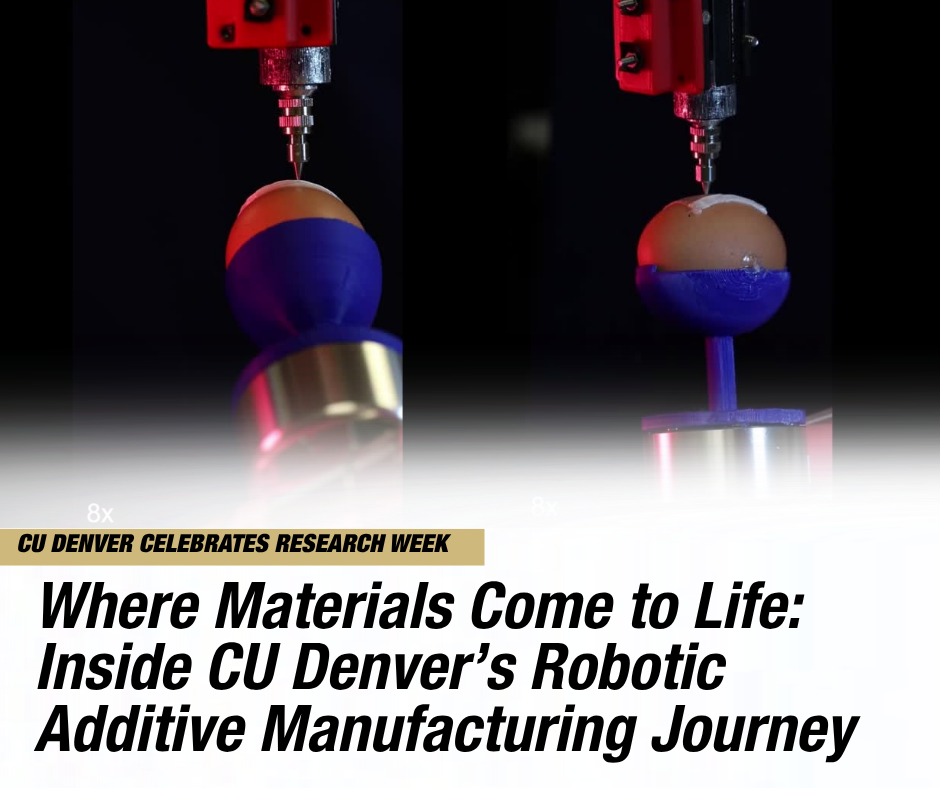
In one demonstration, the team printed a protective, adaptive coating directly onto a raw egg.
The coating absorbed impact during a drop test, leaving the egg intact—highlighting potential applications in protective systems, soft robotics, and advanced materials.
“It is a simple but very powerful demonstration of how robotic additive manufacturing can create functional materials on complex real-world objects,” Yu said. “ I am especially excited about it because it shows how robotic manufacturing can open new possibilities for smart materials, soft robotics, and protective systems.”
The work was recently published in Science Advances.
Hands-On Learning, Real-World Impact
Students are central to Yu’s research program, contributing to every stage of the work. From programming robotic systems to testing materials and developing simulations, students gain hands-on experience across the full research process.
“My students are the driving force behind all the work in my research group,” Yu said. “They are not limited to just one part of the workflow. They gain experience in fabrication, testing, modeling, and data analysis.”
This end-to-end experience is a defining advantage. “They gain experience across the entire process: fabrication, mechanical testing, functional characterization, data analysis.” Students graduate not only with knowledge, but with the confidence and capability to build, test, and innovate in real-world environments.
“It is a rich training environment for students,” says Yu. “Just as importantly, they learn how to approach complex engineering problems in an integrated way by combining experiments, modeling, and critical thinking. I believe that prepares them extremely well for their future careers.”
One standout example is Christopher “CJ” Chung, a former Ph.D. student and lead author on the Science Advances paper.

“His Ph.D. work reflects the kind of training environment I try to create in my lab,” says Yu. “It was incredibly rewarding to see his progression from a student in the classroom to a leading researcher in the lab…He worked across material development, mechanics modeling, experimental validation, and advanced 3D and 4D printing, integrating these areas into a cohesive research workflow.”
Today, he applies those skills in industry, working as a Materials Design Engineer at Colorado-based company Pretred, transforming end-of-life tires into sustainable rubber traffic safety barriers.
“It is very exciting to see him apply the skills he developed in my lab to create safer and more sustainable engineering systems in industry,” says Yu.
CJ’s path reflects a broader reality at CU Denver: students graduate with meaningful experience solving complex, real-world problems and are ready to contribute from day one.
Shaping the Future of Manufacturing
Yu sees robotic additive manufacturing as a transformative force across industries. “I see robotic additive manufacturing playing a major role in the future of engineering because it can fundamentally expand what we are able to design, fabricate, and optimize,” he says.
“One of its most important impacts will be the shift from simply making parts to engineering performance directly during fabrication… We will no longer think only about the external shape of a component, but also about how to program its internal structure, reinforcement layout, and even functional response as it is being manufactured.”
This approach enables engineers to design lighter and stronger structural components, more efficient multi-functional devices, and materials that can adapt, sense, protect, or change shape in service.
The implications are vast: lighter and stronger aerospace components, adaptive biomedical devices, responsive infrastructure, and intelligent soft robotic systems.
“The real significance is not just that it automates printing, but that it opens the door to manufacturing materials and products with combinations of geometry, structure, and functionality that are very difficult to achieve by conventional methods.”
A Distinctive, Interdisciplinary Approach
What sets Yu’s work, and CEDC, apart is its integration of disciplines.
“We are not approaching robotic additive manufacturing as only a fabrication tool,” Yu said. “We view it as an integrated platform for engineering new materials, processes, and product functions at the same time.”
His team develops not only new material systems, including shape-changing and sustainable polymers, but also predictive models to understand how manufacturing influences performance.

“We are not simply making new things—we are building the scientific understanding needed to optimize materials, process conditions, and design strategies in a rigorous way,” says Yu. “The uniqueness of our work lies in this combination: advanced robotic manufacturing, innovative functional materials, strong mechanics-based understanding, and a highly interdisciplinary research environment. That combination positions us to tackle important challenges in manufacturing, materials, and engineering design in ways that can have broad scientific and societal impact.”
CU Denver’s collaborative, interdisciplinary environment positions CEDC at the forefront of next-generation manufacturing.
Advice for Future Engineers
For students interested in robotics, materials, or advanced manufacturing, Yu’s advice is simple: start curious.
“Robotics is inherently interdisciplinary,” Yu said. “It brings together materials, mechanics, control, computation, and design.”
He encourages students to combine theory with hands-on experience, working to build skills step by step and never losing that spark that drives engineering students to ask questions.
“It is important not only to understand concepts, but also to work with real systems, write code, and troubleshoot problems,” Yu said. “That combination is what makes this field so rewarding.”
Start Building What’s Next
The future of engineering is about creating materials that move, adapt, and perform by design. At CEDC, that future is already taking shape in labs like Kai Yu’s, where students are working at the edge of robotics, materials, and design to create systems that move, adapt, protect, and respond in ways that were once impossible.
If you want to design smarter systems, work with cutting-edge technology, and gain hands on experience that sets you apart CEDC is where you start. This is where engineering transforms from discipline to a platform for innovation and real-world impact.
Ready to design smarter systems and shape the future of engineering? Explore CU Denver’s College of Engineering, Design and Computing and start building what’s next.
Leave a Reply