
At the University of Colorado Denver’s School of Engineering, Design and Computing, engineering is more than a discipline, it is a responsibility. A responsibility to solve real problems, to serve communities, and to create pathways for the next generation to do the same.
That responsibility is realized through deeply connected, application-driven research, where students, faculty, and industry partners work side by side to develop solutions that don’t stay in the lab but move into the world.
Few examples capture that approach more clearly than the work of Nam Bui, Assistant Professor of Electrical Engineering at the University of Colorado Denver and Founder of the Intelligent Networked Systems and Cybernetics Laboratory (InsCy Lab).
Engineering Healthcare That Fits Real Life
Bui’s work begins with a simple but essential belief: engineers create solutions for society, and those solutions must fit into the realities of everyday life.
“My research centers on the development of intelligent, networked sensing systems that bridge the gap between clinical necessity and everyday usability,” says Bui. “As the founder of the Intelligent Networked Systems and Cybernetics Laboratory (InscyLab), I lead research in the mechatronic design of wearable and mobile sensing technologies for healthcare platforms. Our work emphasizes practical, real-world deployment of connected sensing systems, with applications spanning health monitoring and extending to robotic for rehabilitation purposes.”
At InsCy Lab, that mindset drives the development of technologies designed not just to function, but to serve.
“My entry into this research field was motivated by the gap between what patients need in today’s connected world and what existing medical technologies can comfortably provide,” says Bui. “At InsCy Lab, we build technology that solves problems people live with every day”
From smartphone-based oxygen sensing to in-ear blood pressure monitoring, each innovation is grounded in a real human need.
“Our eBP ear-worn device, for example, was developed in direct response to the discomfort of traditional blood pressure cuffs, which inflate every fifteen to thirty minutes and severely disrupt sleep and mobility for patients managing hypertension or undergoing hemodialysis,” says Bui. “Our device moves monitoring to the ear canal, and in our pilot study, it meets the accuracy standards set by the Association for the Advancement of Medical Instrumentation.”
This is engineering in its most impactful: identifying gaps in care and delivering solutions that improve quality of life.
“With rapid advances in artificial intelligence and machine learning, my goal is to leverage modern algorithms, embedded systems, and signal processing to create solutions that are not only clinically reliable but also seamlessly integrated into daily living.”
Industry-Connected Innovation
What distinguishes CU Denver is how intentionally it connects innovation to industry. In the InsCy Lab, research is shaped by real-world constraints. From early-stage prototyping to commercialization pathways, CU Denver engineers are working in alignment with the expectations of real markets and real users.
“Innovation and entrepreneurship are essential to ensuring our research creates real-world impact. Publishing papers and building prototypes is important, but our goal is to develop technologies that reach patients and improve lives.” Says Bui.
“At CU Denver, we actively bridge that gap. We have secured patents for key technologies including our in-ear blood pressure monitoring device and wearable sleep systems and have received funding for these innovations.”
Collaborations with startups and industry partners play a critical role in shaping both the direction and rigor of the work.
“I have collaborated with startups such as VitaWave Inc., which have influenced both our research direction and the professional development of our students,” says Bui. “The startup environment introduces a level of accountability that is rarely imposed in traditional academic settings: technologies must perform reliably under real patient conditions, not just in controlled laboratory environments. This expectation compels us to identify limitations early, design for real-world variability, and prioritize solutions that are genuinely deployable.”
“Industry partnerships further enable this translational focus by opening pathways to commercialization-oriented funding, such as the NSF I-Corps program. These collaborations also provide access to advanced manufacturing standards, helping refine designs to better meet customer and clinical expectations, as exemplified by our engagement with Merge Medical Device Studios.”
The result is a model where innovation is continuously validated against real-world use—ensuring that CU Denver technologies are not only novel, but deployable, manufacturable, and ready to scale.
From Research to Real-World Application
Because industry alignment is built into the process, ideas move quickly from concept to application. As Nam Bui shared, his lab has developed a growing portfolio of projects that demonstrate this approach in action:
“Our mobile oxygen saturation measurement approach takes the similar approach demonstrating that a smartphone’s built‑in camera and light source can be used to capture photoplethysmographic signals from the skin. By analyzing subtle, periodic color variations associated with blood volume changes, the system can estimate blood oxygen saturation directly through the phone. This enables users to measure SpO₂ using only their mobile device, without the need for external pulse oximeters or additional hardware.”
Here, innovation is measured by the impact they make on patient lives.
“Our in-ear blood pressure technology recently received OEDIT funding, placing us on a clear path toward FDA-clearance. This is a significant milestone for a project that began as a research prototype and won Best Paper at ACM MobiCom 2019.”
The rapid progression from prototype to regulatory approval illustrates the power of industry-connected research. By aligning with standards, funding pathways, and clinical requirements from the start, CU Denver ensures that innovations are not only scientifically sound but also ready to reach the patients who need them.
“Furthermore, our Taste Sensing project has now received support from the National Science Foundation (NSF),” adds Bui. “These collective milestones provide the critical validation and support necessary to transition our research from the laboratory into real-world clinical applications.”
Beyond diagnostics, research at CU Denver is expanding into emerging, high-impact applications.
“Our 3D volumetric conferencing project introduces a glasses-free 3D display that renders realistic 3D models with low noise and power consumption. It addresses the eye strain and movement fatigue associated with long-term AR/VR use while allowing multiple users to view 3D objects simultaneously from different angles.”
Each of these achievements reflects a deliberate strategy where funding, recognition, and partnerships are leveraged to accelerate deployment, giving students first-hand experience in translating research into impact and placing cutting-edge tech in the hands of the folks who need it the most.
“All of these projects reflect the same core commitment: designing healthcare technology that is not only clinically accurate, but genuinely easier to live with.”
Preparing Students for Industry Leadership
This real-world, industry-connected environment doesn’t just produce innovation. It produces engineers who are ready to lead from day one.
“Student involvement is not peripheral to our research, it is foundational,” affirms Bui. “At InsCy Lab, high school, undergraduate and graduate students collaborate closely to complete projects, contributing substantively to active projects with real clinical partners.”
Students gain direct experience with the tools, systems, and workflows used across the engineering and medical device industries.
“On the hardware side, students engage in PCB design using industry-standard tools such as Altium Designer, mechanical prototyping in SolidWorks, and firmware development for embedded platforms including the ESP32, Raspberry Pi, and Jetson Nano,” says Bui. “On the software side, they build machine learning pipelines using frameworks like PyTorch and TensorFlow, develop real-time data visualization tools, and contribute to data collection and analysis workflows.”
Equally important, they gain exposure to the full lifecycle of innovation, from concept to commercialization.
“For students, these collaborations provide direct exposure to the full commercialization pipeline from prototyping and patent development to investor pitching and regulatory considerations. That experience bridges the gap between research and industry in a way that only classroom learning cannot replicate.”
For students, the impact is immediate and tangible. By the time they graduate from the University of Colorado Denver, they’ve already operated in environments that mirror startups, clinical settings, and commercialization pipelines.
“We have seen two community college students join InsCy Lab as summer interns and go on to be selected for the nationally recognized TRIO McNair Scholars Program, a fellowship for high-achieving students pursuing doctoral education.”
At CU Denver, outcomes like these are not exceptions. By engaging learners across the full educational spectrum, from K–12 through community college and into advanced research, InsCy Lab is expanding access to engineering while building a true pipeline of talent prepared to contribute at the highest levels.
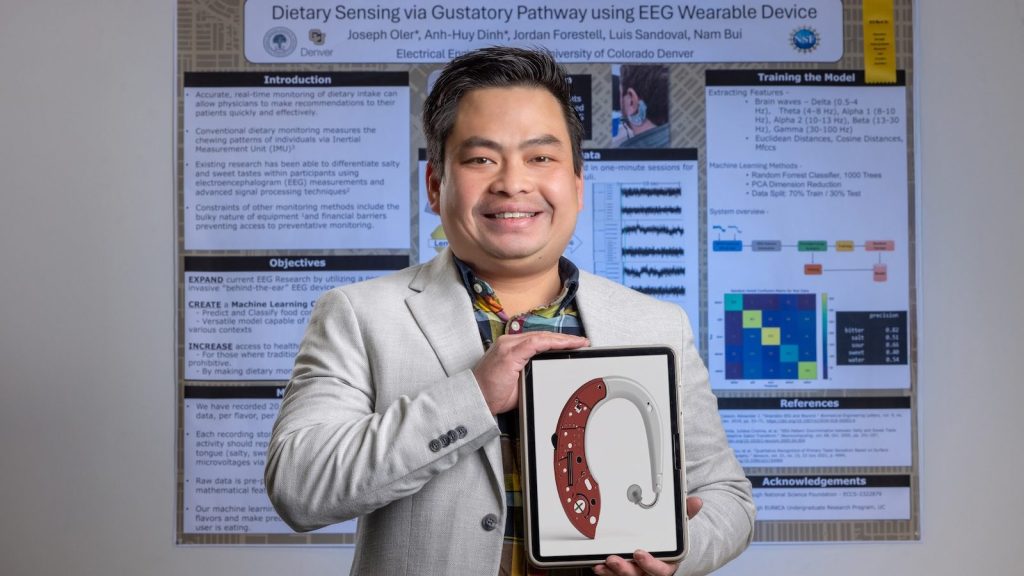
“One example that stands out is our dietary sensing project, where three undergraduate students took on core research responsibilities and produced work strong enough to earn competitive EURēCA Awards from the University of Colorado Denver,” says Bui.
“Furthermore, the other 3 undergrad students have contributed significantly to our 3D volumetric conferencing research and our taste sensing project, taking ownership of complex physics and hardware design challenges that directly advanced these initiatives.”
This level of contribution underscores a defining characteristic of the College of Engineering, Design and Computing: students are doing more than completing assignments, they are advancing real research, contributing to innovation, and building solutions with societal impact.
“These outcomes reflect what is possible when students at every level are treated as genuine researchers and given meaningful responsibility from day one.”
Together, these experiences reinforce CU Denver’s position at the center of applied innovation—where education, research, and real-world impact converge, and where students are empowered to help shape solutions that extend far beyond the classroom.
Engineering that Delivers
Through deep industry integration, applied research, and commitment to real-world outcomes, the College of Engineering, Design and Computing is positioning itself, and its students, at the leading edge of innovation.
“Healthcare is moving toward continuous, personalized, and easy monitoring and my work is designed to lead that shift,” says Bui. “Today, most patients are monitored only during occasional clinic visits, which provides an incomplete picture of their health. We believe critical conditions should be detected before they become emergencies, not after.”
“The goal is for everyday devices like earphones and wearables to continuously track health data and alert clinicians to early warning signs. Our work has been recognized through the ACM SIGMOBILE and Communications of the ACM Research Highlights, reflecting strong confidence in this direction from the broader research community.”
For students—and future engineers—this is an open invitation.
“My advice to students would focus on three things:
First, build strong foundations in both hardware and software. The ability to work across both domains is a genuine advantage in any Engineering field.
Second, understand the problem before designing the solution. Spend time with projects in depth understanding problems, ideas and solutions.
Third, be proactive. Research experience, mentorship, and entrepreneurship opportunities are available to students who seek them out. At InsCy Lab, we welcome students who are curious and committed to work that creates meaningful impact.”
At CU Denver, engineering is embedded in community, driven by purpose, and executed in partnership with industry. The result is a model where innovation doesn’t stop at discovery, but advances into application, reaches the people it was designed to serve, and inspires the next generation to build what comes next.
Come build the next life-changing technology at CU Denver. Apply Today!
 College of Engineering, Design and Computing News
Leave a comment