
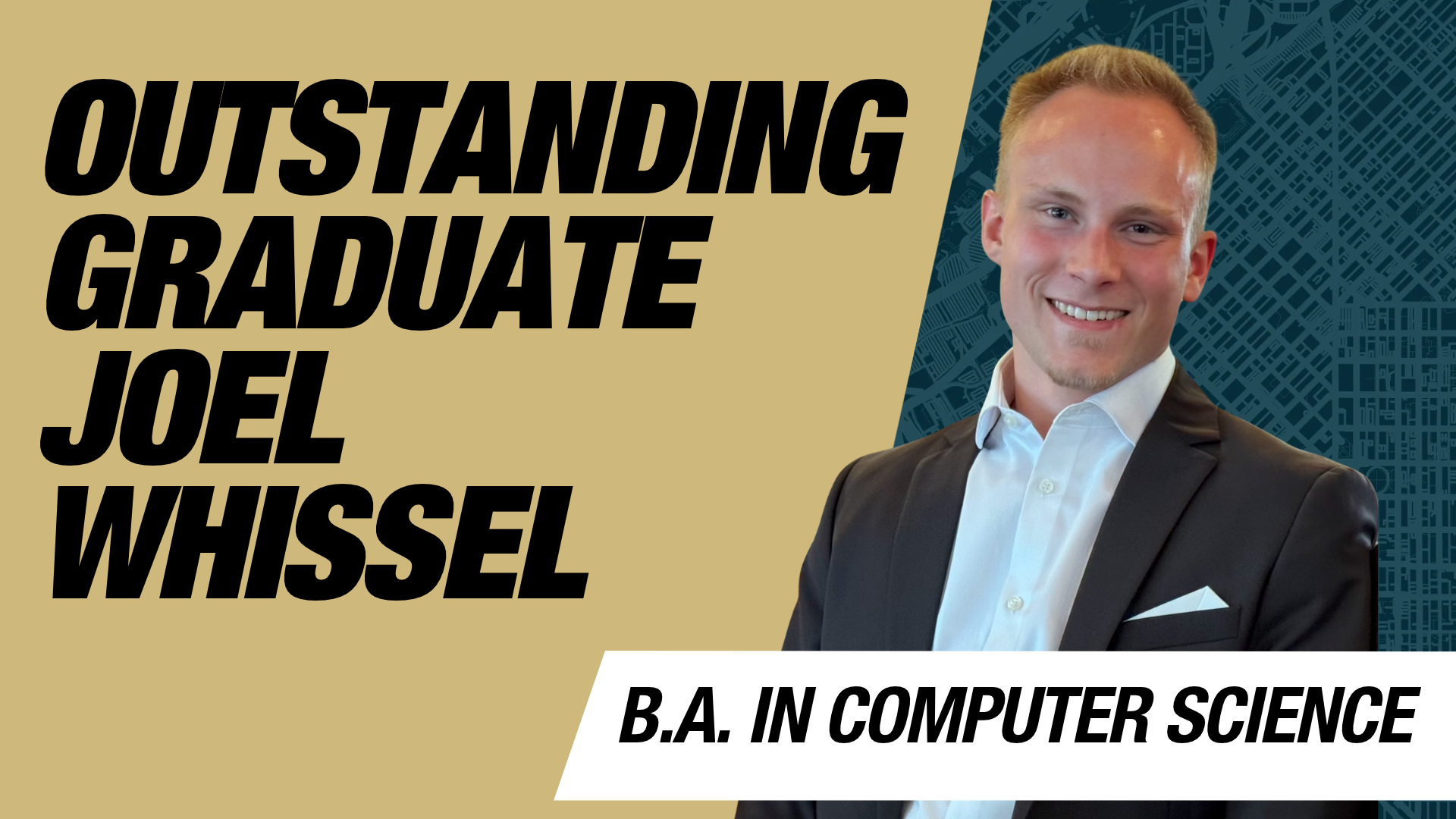
From cybersecurity research with CrowdStrike to developing generative AI models, the graduating student built technical expertise, industry connections and the confidence to take on complex challenges.
For Joel Whissel, some of the most valuable lessons at the University of Colorado Denver happened when he stepped beyond familiar coursework and took on challenges with real-world stakes.
While pursuing his degree at CU Denver’s College of Engineering, Design and Computing (CEDC), Whissel balanced demanding classes, undergraduate research and a software engineering internship. Along the way, he collaborated with cybersecurity professionals, developed artificial intelligence models and presented research to industry leaders.
Each experience strengthened his technical abilities while helping him develop the confidence and professional skills to succeed beyond graduation.
Now preparing to graduate, Whissel is celebrating an education that connected classroom learning with the technologies, challenges and professional environments shaping the software industry.
His journey reflects CU Denver’s emphasis on applied learning, faculty expertise and industry-connected opportunities that help students build meaningful experience before earning their degrees.
Taking on Real-World Cybersecurity Challenges
One of Whissel’s most memorable experiences came through the Data Mine of the Rockies, a collaborative research program connecting university students with industry partners to solve complex problems.
Working with cybersecurity company CrowdStrike and students from across the country, Whissel helped develop analytical methods for high-dimensional data representing cybersecurity threats.
The project gave him an opportunity to apply technical concepts to a challenge facing an industry responsible for protecting increasingly complex digital systems.
The semester culminated in a presentation at the Space Information Dominance Expo, where Whissel and his teammates shared their research with cybersecurity industry leaders.
“The project helped me gain invaluable experience in applied research, agile software development, and public speaking,” he said.
For Whissel, the experience connected technical research with the collaboration, communication and problem-solving skills expected in professional software development.
It also demonstrated how CU Denver students can engage with industry challenges and build professional experience while still completing their degrees.
Learning the Technology Shaping Tomorrow
Whissel’s preparation extended into the classroom, where he explored the technical foundations of software engineering alongside emerging applications of artificial intelligence. The experience gave him a deeper understanding of the technologies behind large language models and the increasingly sophisticated AI systems being integrated into software products and services.
“Many of my classes have included hands-on experiences that helped me prepare for what’s next,” Whissel said. “In Generative Deep Learning, I implemented, trained, and deployed multimodal generative AI models with NVIDIA compute, giving me a real understanding of the mechanics behind the LLMs shaping our future.”
That exposure to emerging technologies was grounded in rigorous instruction in software engineering fundamentals.
“In my core courses, faculty went deep on fundamentals like algorithms and databases, building the foundation I’ll rely on as a software engineer,” he said.
For Whissel, learning how complex systems work was as important as learning how to build them. “Those experiences have prepared me to not only build software, but also to think critically about the systems that shape our lives,” he said.
Balancing Ambition With Opportunity
Among Whissel’s proudest accomplishments is the way he balanced multiple demanding commitments throughout his college experience.
Alongside his academic coursework, he pursued undergraduate research and worked as a software engineering intern, gaining experience across academic and professional environments.
“I’m most proud of maintaining a strong focus on academics while working as a software engineering intern and doing undergraduate research,” Whissel said. “It would have been easy to treat those as competing priorities, but I learned to carefully prioritize and budget my time each week to adapt to changing workloads.”
Managing those responsibilities required discipline, flexibility and the ability to adjust as projects and deadlines changed.
The experience helped him develop habits that will continue to serve him as a software engineer.”I’m proud that I’ll be able to carry those habits forward throughout my career,” he said.
Finding Growth in the Challenge
As Whissel prepares for graduation, his advice to future CEDC students reflects the mindset that shaped his own experience: Seek opportunities that challenge you.
“College is what you make of it, and the biggest growth comes from the things that feel hard,” Whissel said. “Sign up for the tough class, take on the project that scares you, and ask the question no one else does.”
It’s an approach reflected throughout his time at CU Denver, from exploring advanced AI systems to collaborating with industry professionals on complex cybersecurity research.
Whissel credits a mentor with a phrase that has stayed with him.
“I have a mentor whose favorite saying is ‘Hard stuff is cool!’ and I’ve found that to be true,” he said. “The challenges you lean into now are what you’ll be proudest of later.”
For Whissel, those challenges have become defining accomplishments: research presented to industry leaders, experience developing AI models, a software engineering internship and the ability to balance ambitious goals.
As he joins his fellow CU Denver graduates, he carries forward a foundation built through technical rigor, professional collaboration and the willingness to tackle unfamiliar problems.
His experience reflects what an industry-connected engineering and computing education can make possible: Students graduate having already contributed to meaningful work, developed valuable professional skills and gained the confidence to take on what comes next.
For Whissel, the most rewarding opportunities began with the decision to embrace a challenge, and that mindset will continue to shape the work ahead.
Build Your Future in Computing
From artificial intelligence and cybersecurity to software engineering and applied research, CU Denver’s College of Engineering, Design and Computing connects students with faculty expertise, industry partners and opportunities to gain experience before graduation.
Leave a Reply