
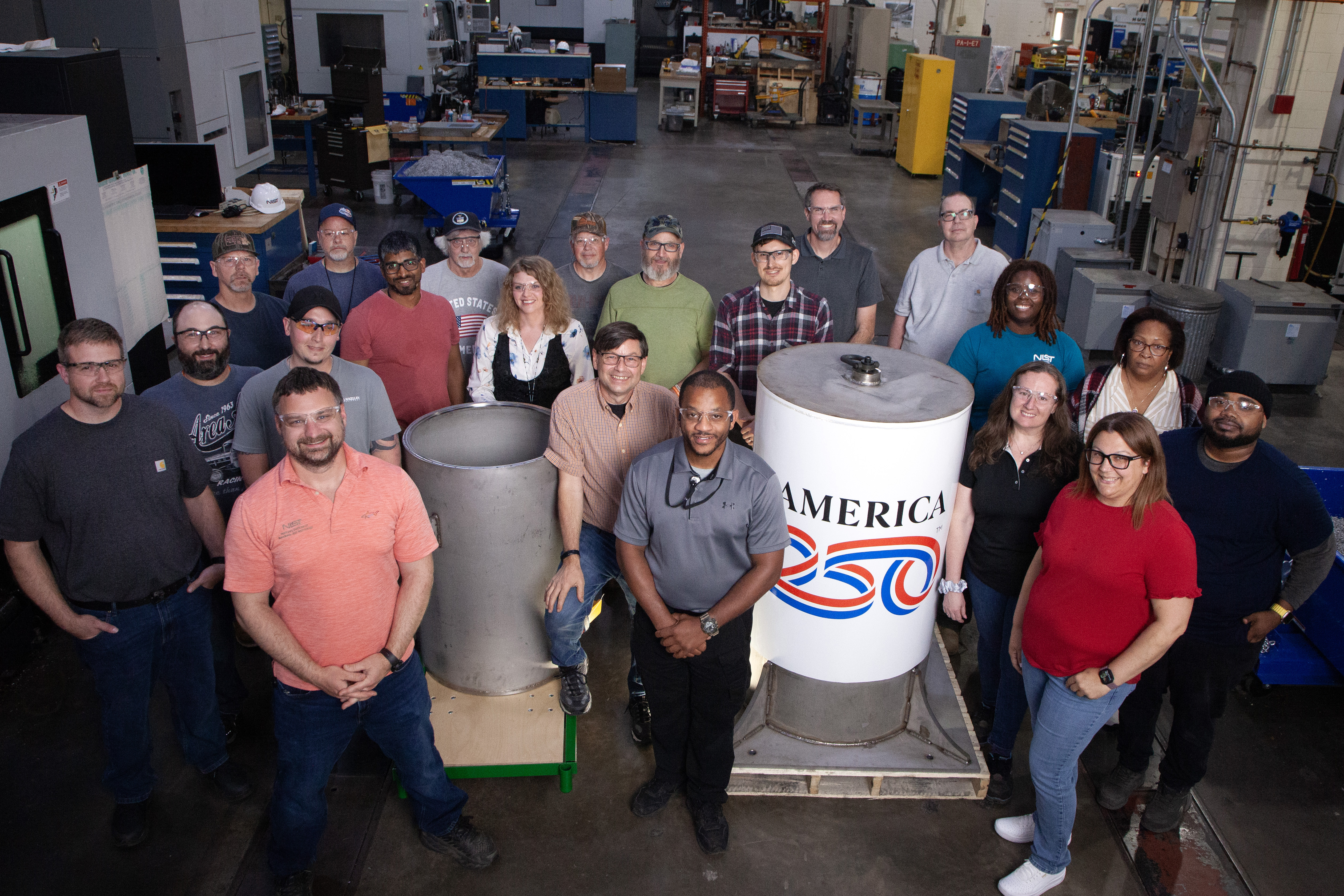
A CU Denver internship launched Jay Nanninga’s career at NIST. Today, he’s engineered one of America’s most significant historical preservation projects.
Most mechanical engineers expect to spend their careers designing machines, solving manufacturing challenges or developing new technologies. Few expect their work to become part of American history.
For Jay Nanninga, BS Mechanical Engineering ’11, that opportunity arrived through one of the nation’s most significant historical preservation projects.
As a mechanical engineer at the National Institute of Standards and Technology (NIST), Nanninga helped engineer and fabricate the official America250 congressional time capsule, a vessel designed to protect historic artifacts commemorating the nation’s 250th anniversary.

The project brought together experts from NIST, the Library of Congress and America250, combining engineering, preservation science and history in a way few careers ever do.
“It was a special project unlike any other I have been involved with,” Nanninga said. “It was an incredible privilege to work on such a patriotic and meaningful venture.”
One Internship. One Career. One Historic Opportunity.
Long before he was helping preserve history, Nanninga was a mechanical engineering student at CU Denver looking for experience outside the classroom.
As a junior majoring in mechanical engineering, he applied for a NIST internship through the federal Pathways Program. That single decision changed the trajectory of his career.
“That decision to take the internship is the main reason I work at NIST today,” says Nanninga. “Career-wise, it was one of the best decisions I’ve ever made.”
After graduating, NIST hired him as a full-time mechanical engineer, a moment that confirmed his CU Denver education had opened the door to the career he envisioned.
“The reality of earning a meaningful mechanical engineering job came into view when NIST rolled me over from a Pathways student to a mechanical engineer after I completed my degree,” he says.
For Nanninga, the experience demonstrates why internships remain one of the most valuable opportunities engineering students can pursue.
“Engineering students have a unique opportunity while in school to take advantage of engineering internships,” he said. His advice to future students is to: “Study with diligence and purpose, be open to and ready to act on available opportunities.”
Engineering for Centuries
Designing a product with a 250-year design life forces engineers to confront a problem almost no one can test.
“One engineering challenge of this project was time,” Nanninga said. “Scientists have studied stainless steel for only one hundred years, and the time capsule needs to survive for two hundred and fifty years.”
The engineering challenges extended far beyond selecting durable materials. Engineers couldn’t predict what Philadelphia’s groundwater would look like in 2276, but they knew the capsule had to survive it. Engineers at NIST designed a massive bell-shaped enclosure that functions much like a diving bell, passively preventing groundwater from reaching the capsule.

The team’s greatest fabrication challenge came during the project’s final moments: sealing the capsule after every artifact had been placed inside.
Traditional welding carried too much risk. The heat and sparks could have damaged the priceless historical documents stored within. Instead, Nanninga and the engineering team relied on an elegant materials engineering solution.
“We chose an indium wire seal,” Nanninga explained. “Indium is a soft metal that fits into a custom groove at the top of the capsule. When we lowered the lid on top of it, the pressure crushed the indium wire between the two sealing surfaces, forming a cold weld and creating an airtight and waterproof seal between the lid and the pipe.”

The result is a capsule engineered to withstand centuries while protecting the documents and artifacts inside, an example of how innovative engineering can solve problems that extend far beyond a typical product lifecycle.
Where Classroom Challenges Become National Projects
Nanninga credits CU Denver’s emphasis on hands-on engineering education with preparing him for projects where there is no margin for error.
“Coordinating and completing the senior design project had similarities to the America250 time capsule project,” says Nanninga. “Dealing with non-negotiable due dates, unexpected design changes, and fabrication issues were solved with the same skills and tools that I learned at CU Denver”
That experience reflects the philosophy behind CU Denver’s two-semester Senior Capstone Design Project, where multidisciplinary teams partner with industry, government and nonprofit organizations to solve authentic engineering challenges before graduation.

Nanninga says among the projects that remain especially influential to his approach to engineering are the Scorpion senior design vehicle he helped design and build and a medical device he modeled alongside a surgeon at the University of Colorado Anschutz Medical Campus that later received a U.S. patent.
Just as important were the faculty mentors who challenged him to grow.
Nanninga credits Doug Gallagher with influencing his engineering strategies through years as an instructor, supervisor and mentor, while Mechanical Engineering Chair Ron Rorrer pushed him to stretch beyond what he believed he could accomplish.
“Their knowledge, expectations and mentorship continue to influence how I approach engineering today,” he said.
An Engineering Degree Can Take You Anywhere—Even Into History
Although the America250 project carries enormous historical significance, Nanninga says success still depended on the same engineering fundamentals students learn in college: collaboration, problem solving, precision and persistence.
When Americans eventually open the time capsule centuries from now, they’ll discover more than historical artifacts. Inside the capsule is a sealed vessel containing photographs and signatures of the NIST engineers who designed and built it—including Nanninga himself.

“Hopefully those documents will give future Americans a sense of who we are,” he said.
They will also find the legacy of the educational journey that prepared him for that responsibility: a CU Denver engineering education built on curiosity, innovation and the ability to solve challenges that had never been imagined. Nanninga’s journey illustrates a powerful reality about engineering: the most meaningful careers are often the ones no one can predict.
Whether designing the next generation of robotics, advancing clean energy solutions or preserving a piece of American history, mechanical engineering graduates are equipped to make an impact wherever innovation leads. At CU Denver, students are prepared not only for the careers they expect, but for the opportunities they have yet to imagine.
Explore Mechanical Engineering at CU Denver and discover where engineering can take you.
Leave a Reply