
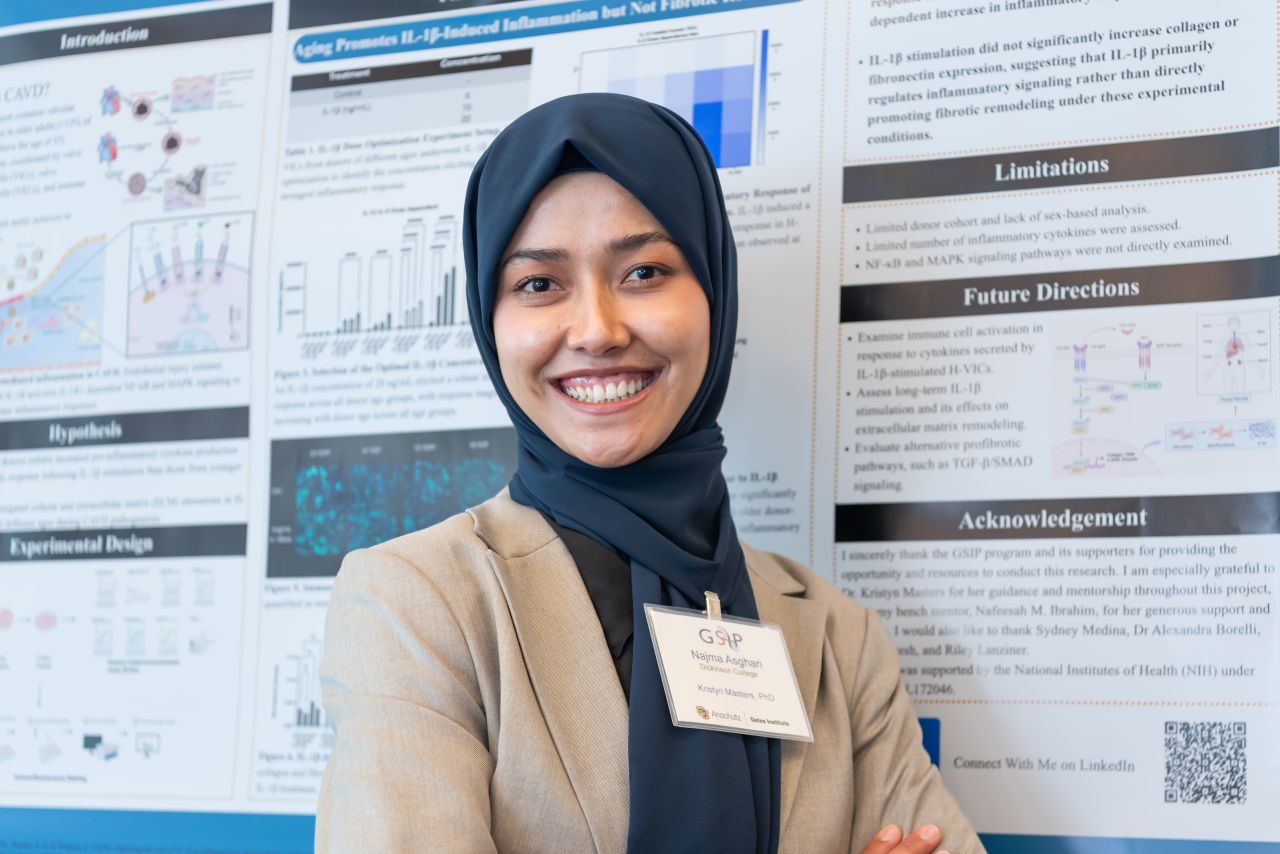
An 11-week summer internship gave one student more than laboratory experience. It gave her the chance to test a possible future and discover that she wanted it.
There is a difference between studying science and seeing yourself becoming a scientist. Najma Asghari came to CU Denver | Anschutz looking for that distinction.
An international student from Afghanistan studying biochemistry and molecular biology at Dickinson College in Pennsylvania, Asghari had spent years learning science in classrooms. But one question remained difficult to answer from a textbook: Could she actually see herself building a life in research?
This summer, she stepped inside one of our biomedical engineering labs to find out.
Through the Gates Summer Internship Program, Asghari spent 11 weeks in the laboratory of Kristyn Masters, PhD, chair of the Department of Biomedical Engineering at CU Denver | Anschutz. She worked with human cells, analyzed experimental results and learned techniques used by biomedical researchers investigating cardiovascular disease.
She also encountered failed experiments, complicated data and the uncertainty that comes with asking questions no one has completely answered.
But the internship offered something more valuable than a preview of research. It gave Asghari the freedom to test her assumptions about the kind of work she wants to pursue.
By the end of the summer, she had learned how she responds when results are unexpected, how she approaches problems without clear answers and how much she values the process of discovery.
That clarity is one of the most powerful outcomes of hands-on engineering education. Students do not have to choose a career path based only on what sounds interesting from a distance. They can step into the work, experience its challenges and discover whether it energizes them.
For students exploring engineering, science and healthcare, experiences like Asghari’s can answer a question every bit as important as what to study: Will I like the career path I am preparing for?
Finding engineering by doing it
Engineering contains far more possibilities than most students encounter before college.
A student interested in medicine might discover biomedical engineering. Someone drawn to biology could find a future in biomaterials or tissue engineering. A fascination with data, devices, physics or chemistry can lead toward entirely different problems, sometimes within the same laboratory.
The challenge is discovering those possibilities so you can pursue them. At CU Denver’s College of Engineering, Design and Computing and through its connections with the CU Anschutz Medical Campus, students can encounter engineering through research, internships, design projects, laboratories and interdisciplinary collaborations so they can see for themselves all the opportunities engineering opens up.
For Asghari, biomedical research became the place where several interests converged. Her research focused on calcific aortic valve disease, examining how cells respond to inflammatory stimulation and what those responses could reveal about potential therapeutic targets.
That meant moving beyond concepts she had encountered in class and learning how biomedical research actually happens. She gained experience with cell culture, immunofluorescence, ELISA techniques, experimental design and data analysis.

Before long, the research challenged her assumptions. A reagent that had worked successfully in porcine cells did not behave the same way in human cells. What initially looked like a failed experiment became something more useful: information.
“Negative results are still results,” Asghari said. “It has definitely saved someone else’s time.”
That realization changed how she understood research. Progress does not always arrive as a successful experiment. Sometimes it comes from eliminating an approach, refining a question or finding evidence that sends the next researcher in a better direction.
Those are difficult lessons to simulate in a classroom. Inside an active research lab, they become part of the work.
Mentorship turns experience into opportunity
The internship also gave Asghari something equally important: mentorship.
Her mentor, Nafeesah Ibrahim, gave her room to take ownership of her work while remaining available when she needed guidance. Other members of the lab shared their time and expertise.
Asghari was trusted to figure things out, knowing she would be supported when things got difficult.
Near the end of the internship, the amount of data she had collected began to feel overwhelming. “I was like, wow, this is a lot. I cannot do this,” she said.
Her mentor helped her step back and look at the bigger picture: Find the story the research is telling. That advice changed how Asghari approached her work.
“It doesn’t matter how much work you’ve done and how much effort and time you’ve put in if you cannot tell the story about your research,” she said.
Learning to tell that story became one of the most important outcomes of her internship. The experience showed her that engineering is not only about technical knowledge. It is also about curiosity, judgment, communication and the ability to find meaning in uncertainty.
Those are the skills that turn hands-on experience into career direction.
Building a career starts with trying it
For Asghari, the internship helped turn an abstract career possibility into something she could actually picture.
She now knows she wants to pursue a PhD. She is considering adding a physics minor to deepen her preparation for biomedical engineering. And she has a much more concrete understanding of what a research career looks like, not from the perspective of a published paper, but from inside a working laboratory.
That is the value of opportunities that let you meet your moment. Students can take what they learn in class and put it to work. They can explore research questions alongside faculty and mentors. They can develop technical and professional skills. And they can use those experiences to make more informed decisions about what they want to do next.
For Asghari, the experience also confirmed something she had been trying to discover all along: She loves research.
“Doing this internship, I feel like now I have a way better understanding of how research works,” she said. “It kind of confirmed my passion toward science.”
Your career starts with experience
At CU Denver’s College of Engineering, Design and Computing, students can explore what is possible through research, internships, industry-connected projects and experiences that put them closer to the work, people and problems shaping their fields.
Leave a Reply