
For Manufacturing Month , step inside a CU Denver lab where researchers are developing a new incremental sheet forming approach for advanced composites.
We live in a world built for mass production. The same car part, medical device or piece of equipment can roll off an assembly line thousands of times. In this model, investing the time and money to build specialized molds and tooling makes sense.
But what happens when an engineer needs 10 specialized components instead of 10,000?
Across aerospace, transportation, healthcare and energy, engineers are being asked to make products lighter, smarter and more specialized. A lightweight aircraft component might require a specialized internal fiber structure. A medical device might need a shape tailored to a particular application. A prototype might exist as only a single part.
For those applications, building dedicated tooling for every new design adds significant time and cost.
Inside CU Denver’s College of Engineering, Design and Computing, Associate Professor Kai Yu, PhD, and his mechanical engineering research team are exploring a solution: Changing the way the material itself is designed and formed.
Shaping a Part Without a Dedicated Mold
Yu’s research focuses on advanced composites, materials that combine lightweight polymers with strong reinforcing fibers. Their strength and low weight make them valuable for applications ranging from aircraft and vehicles to energy systems and medical technology.
At the center of the research is incremental sheet forming, or ISF, a flexible manufacturing process that Yu’s team is now developing for continuous-fiber composites.
Instead of pressing an entire sheet into a fixed mold, ISF uses a relatively small forming tool that follows a computer-controlled path. Moving across the material step by step, the tool progressively shapes the sheet until a three-dimensional structure emerges. That gives engineers greater flexibility over the final geometry, But there is a catch.
“The same fibers that make composites strong also make them difficult to form using ISF,” Yu said. “Continuous fibers resist stretching along their length, so they cannot accommodate local deformation in the same way as a metal or an unreinforced polymer sheet.”
To address that challenge, Yu’s team is pairing ISF with another technology that provides greater control over the material before forming even begins: additive manufacturing.
“We need to engineer both the fiber architecture and the polymer matrix, and understand how fibers move, rotate and reorganize during forming without sacrificing the performance of the final structure,” Yu said.
Rather than beginning with a conventional composite sheet, the team can use additive manufacturing to design the starting material itself, controlling characteristics such as fiber arrangement, thickness and composition before it is formed.
“Additive manufacturing gives us tremendous freedom to design the starting material, while incremental forming gives us tremendous freedom to create the final geometry,” Yu said. “The exciting opportunity is to bring those two capabilities together.”
In other words, engineers could gain control over two things at once: the shape of a component and how the material inside it is arranged to deliver the desired performance.
Bringing AI Into the Manufacturing Loop
Yu’s team is also bringing artificial intelligence into the process.
The team plans to combine computational simulations with experimental data to develop AI-assisted models that can predict how a composite sheet will behave as it is formed.
The longer-term goal is known as inverse design.
Instead of beginning with a manufacturing process and asking what it can make, an engineer could begin with the desired result. What should the component look like? What performance does it need to achieve? How should the fibers or other materials be arranged?
A computational system could then help work backward, determining the starting material, fiber arrangement, material distribution and forming toolpath needed to produce the desired part.
That capability could be particularly useful for specialized manufacturing, where production quantities are small and the geometry or performance requirements can change from one component to the next.
A medical device could require a shape tailored to a particular application. An aircraft replacement part might be needed in a single configuration. In industries where highly specialized components can serve critical functions, the ability to produce small quantities without investing in dedicated tooling could open new possibilities for how quickly and efficiently manufacturers respond to specific needs.
From a Research Question to Parts You Can Hold
This is the kind of engineering challenge that crosses traditional boundaries between physical experimentation, manufacturing and computation. Students in Yu’s lab are gaining experience across all three.
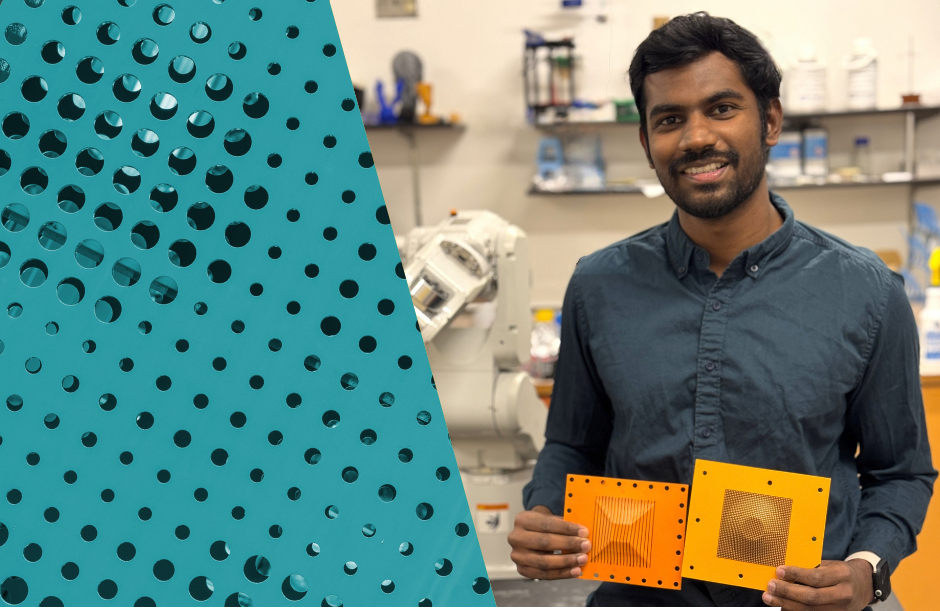
PhD student Alston Xavier Gracego has played a central role in developing the hybrid additive manufacturing-incremental forming process. He designs customized composite sheets, forms them into three-dimensional structures and studies what happens to the reinforcing fibers as the material takes shape.
“What excites me most is that we are not only shaping the final part,” Gracego said. “We can also design where the fibers go and how they are arranged after forming. That gives us another level of control over how the structure ultimately performs.”

PhD student Alston Xavier Gracego holds incrementally formed composite shells developed through his research.
Now, he is taking the concept further. Gracego’s research is expanding beyond conventional structural carbon fibers to multifunctional reinforcement, including electrically conductive and optical fibers.
The longer-term possibility is a composite structure that does more than withstand mechanical forces. Sensing, electrical or optical functions could potentially be incorporated directly into the material. Instead of manufacturing a component and adding sensors or other technologies later, engineers could eventually design some of those capabilities into the material from the beginning.
A new three-year, $607,204 National Science Foundation award beginning in October 2026 will support the next stage of Yu’s research, as his team further develops the materials, manufacturing processes and computational models needed to understand and control how these composite structures are made.
The award also creates opportunities for students to contribute to federally funded research while building experience across advanced materials, manufacturing and computation. For Gracego, that means graduate education is not separate from discovery. He is helping investigate what these emerging manufacturing methods could make possible.
Preparing Engineers for What Manufacturing Becomes Next
For students entering mechanical engineering, work like this offers a view of a profession in transition. Materials, manufacturing, computation and AI increasingly intersect, requiring engineers who can work across disciplines and understand how these technologies function together.
In Yu’s lab, students are developing that perspective while the technologies themselves are still taking shape. They are not simply learning how advanced manufacturing works today; they are contributing to research that could influence how it works tomorrow.
That brings the research back to the question at its center:
What could engineers make if the mold no longer determined what was possible?
Answering that question will require new materials, new manufacturing methods and engineers capable of connecting the physical and digital worlds.
At CU Denver, researchers are exploring what becomes possible when the mold no longer sets the limits, with students playing a central role in shaping what comes next, from how materials are designed to what engineers can ultimately create.
Explore mechanical engineering at CU Denver’s College of Engineering, Design and Computing and discover how students work alongside faculty researchers on advanced manufacturing, materials and emerging technologies shaping how products are designed and made.
Leave a Reply