
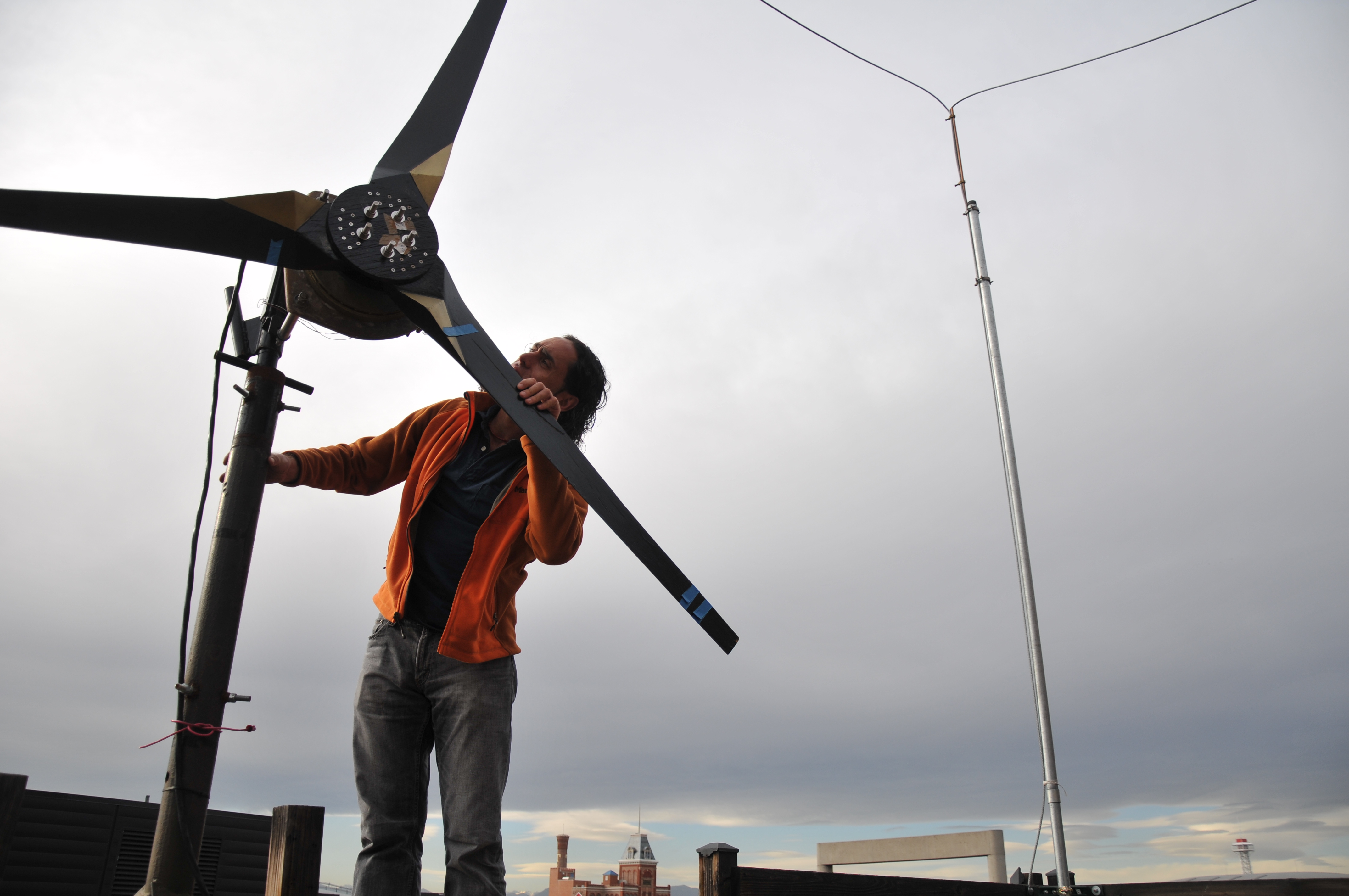
During National Clean Energy Week, CU Denver engineers are tackling what comes after renewable electricity is generated — making it reliable, integrating it into the grid and preparing students to build the energy systems of the future.
A wind turbine can generate electricity without direct emissions during operation. A solar panel can produce power when the sun is shining. But generating energy is only one part of the clean energy transition challenge.
What happens when freezing rain coats its blades, wind conditions suddenly change or thousands of megawatts of variable renewable power must be balanced against electricity demand in real time? How do we make clean energy reliable enough, resilient enough and controllable enough to power the systems people depend on every day?
Getting that electricity reliably to the homes, hospitals, businesses, electric vehicles and data centers that depend on it requires another layer of engineering, one that involves weather forecasting, power electronics, artificial intelligence, energy storage, grid controls and increasingly complex decisions about when and where electricity should flow.
Researchers at CU Denver’s College of Engineering, Design and Computing are looking beyond how clean electricity is generated to tackle what comes next: how to make renewable power more resilient, integrate it into an evolving electrical grid and prepare the engineers who will design the energy systems of the future.
For students, those questions aren’t waiting for some distant point in their careers. They’re becoming research projects, course assignments and opportunities to work alongside faculty on problems the energy industry is trying to solve now.
When the weather changes, the grid has to respond
Wind energy illustrates both the opportunity and the complexity of the clean-energy transition.
“Wind energy has become a major contributor to the global energy transition, supplying approximately 11% of global electricity by the end of 2025,” says Linyue Gao, PhD, assistant professor of mechanical engineering. “The stochastic nature of wind creates challenges for power system resilience, as higher wind penetration can lead to greater power fluctuations and supply–demand imbalances. These challenges can become even more severe during extreme weather events, such as snowstorms, freezing rain, and hail, which may force wind turbines to shut down for hours or even days.”
So how do we account for an energy source that doesn’t work on a utility schedule? Through laboratory experiments, field campaigns and data-driven modeling, Gao approaches the problem from several directions.
“My research focuses on understanding how extreme weather affects wind turbine operation, power production, and structural integrity through laboratory experiments, field campaigns, and data-driven modeling. I also develop protection and mitigation strategies for wind turbines under severe weather conditions, as well as AI-driven wind power forecasting tools that enable power system operators to improve power dispatch and planning before and during extreme weather events.”
It is research at the intersection of mechanical engineering, atmospheric conditions, data science and power systems , and it demonstrates why building a cleaner energy system increasingly requires engineers who can work across disciplines.
But predicting how much renewable electricity will be available is only one part of the problem. Engineers also have to make that electricity work with the grid.
Turning renewable electricity into grid-ready power
Solar photovoltaic systems and wind turbines don’t inherently produce electricity in the form required by the utility grid. Voltage, current, frequency and power quality must be carefully managed before renewable electricity can be delivered reliably.
In other words, the clean-energy transition is not only about building more renewable generation. It is also about developing the technology that allows those resources to become functioning parts of a complex electrical system.
That is where Fernando Mancilla-David, PhD, professor of electrical engineering, focuses much of his research.
“My research focuses on developing advanced power electronic systems together with control and optimization strategies that facilitate the reliable integration of renewable energy resources into modern power systems,” says Mancilla-David. “By making it possible for diverse energy sources to operate seamlessly with the electric grid, this work helps build energy systems that are cleaner, more reliable, and better equipped to meet the growing demand for sustainable electricity.”
The challenge is growing more complex. Today’s grid is being asked to accommodate renewable generation, battery storage, rooftop solar, electric vehicles and other distributed energy resources while simultaneously responding to new sources of electricity demand, including data centers.
Rather than simply generating electricity and sending it in one direction, the emerging grid must become more flexible and responsive.
Mancilla-David’s research group is exploring how advanced power electronics, optimization, machine learning and artificial intelligence can help make that possible.
“Renewable energy technologies are becoming far more than just sources of electricity. Thanks to advances in power electronics, these resources can now be actively controlled and coordinated to support the operation of the electric grid,” says Mancilla-David. “Rather than simply injecting power, renewable energy systems can provide valuable flexibility, creating additional degrees of freedom that enable operators to optimize the performance, reliability, and efficiency of the entire power network.”
Together, Gao’s and Mancilla-David’s work reveals how interconnected the clean-energy challenge has become.
A wind turbine must withstand extreme weather. Its future output must be anticipated. The electricity it generates must be converted into grid-compatible power. Grid operators must balance that variable generation against changing demand. Storage, electric vehicles and intelligent controls can then become part of the system used to manage those fluctuations.
Each challenge leads directly to another. And each creates an engineering problem students can help solve.
Students aren’t watching the energy transition. They’re working on it.
For students considering engineering, the scale of those challenges creates a lot of opportunity.
At CU Denver, renewable energy research moves into classrooms, laboratories, capstone projects and faculty-led research, giving students the chance to develop technical skills around technologies already reshaping the energy industry.
Gao developed a Renewable Energy course focused on wind energy.
“Our Renewable Energy course is focused on wind energy to prepare CU Denver students for careers in the growing clean-energy workforce,” says Gao. “The course equips students with industry-relevant, hands-on skills in wind resource assessment using real-world met tower data, wind turbine design, and wind farm simulation, strengthening their readiness for careers in renewable energy.”
Students studying electrical engineering encounter the other side of the system.
In Mancilla-David’s “Grid Integration of Renewable Energy” course, project-based assignments address current power-industry challenges. Some have developed into conference papers and other scholarly publications.
“Students are active participants in nearly every aspect of my research program,” says Mancilla-David. “At the undergraduate level, I have mentored several senior capstone teams working on renewable energy and power systems projects with practical applications. These projects often involve collaboration with industry partners, giving students valuable exposure to the types of technical problems they will encounter in their professional careers.”
These hands-on experiences change what it means to study clean energy in engineering. From day one, students are working with real-world data, modeling systems and considering the engineering decisions are required to make renewable resources function in the real world.
That is part of the opportunity of studying engineering at CU Denver: students encounter problems engineers are actively working to solve early so they can be ready to contribute once they join the workforce.
Building what comes after the energy transition
The next decade of clean energy will bring its own engineering questions. Engineers will need to make renewable generation more resilient to extreme conditions. They will need better forecasts, more capable storage, smarter controls and advanced power electronics. They will have to integrate electric vehicles and new sources of demand without sacrificing the reliability people expect every time they flip a switch.
Gao sees continued advances in wind technology, battery storage and modern power systems and markets as reasons for optimism.
“Looking ahead 10 years, I am optimistic that continued advances in wind technology, battery storage, and modern power systems and markets will make wind energy even more competitive and reliable. Wind itself is a free resource, and electricity can be generated without direct emissions during operation. Together, these advantages give me great confidence in the future of wind and clean energy.”
For the students who will enter the profession during that next decade, the opportunity is larger than learning to operate an energy system someone else designed. They can help determine what replaces it.
“The field of electrical engineering is entering one of the most exciting periods in its history. The global transition toward cleaner energy, the rapid growth of electrification, advances in artificial intelligence, and the increasing digitalization of infrastructure are creating new opportunities for innovation across virtually every sector,” says Mancilla-David. “At the same time, these developments are raising new engineering challenges that require creative thinking, sound technical judgment, and interdisciplinary collaboration.”
At CU Denver, those challenges are already part of an engineering education. Students learn from faculty advancing wind energy and modern power systems, work with real-world energy data, contribute to research and tackle projects connected to problems utilities and energy companies are confronting now. The result is an opportunity to build technical expertise while gaining experience with the technologies and questions shaping the future of the energy industry.
The clean-energy transition will require engineers who can make renewable resources more reliable, connect them intelligently to the grid and rethink how energy moves through an increasingly complex world. At CU Denver, students have already started to build towards the future of energy.
Explore the future of energy at CU Denver.
Learn how CU Denver’s mechanical and electrical engineering programs connect students with renewable energy research, faculty mentorship, industry-relevant projects and opportunities to help build a cleaner, smarter and more resilient energy system.
Leave a Reply