
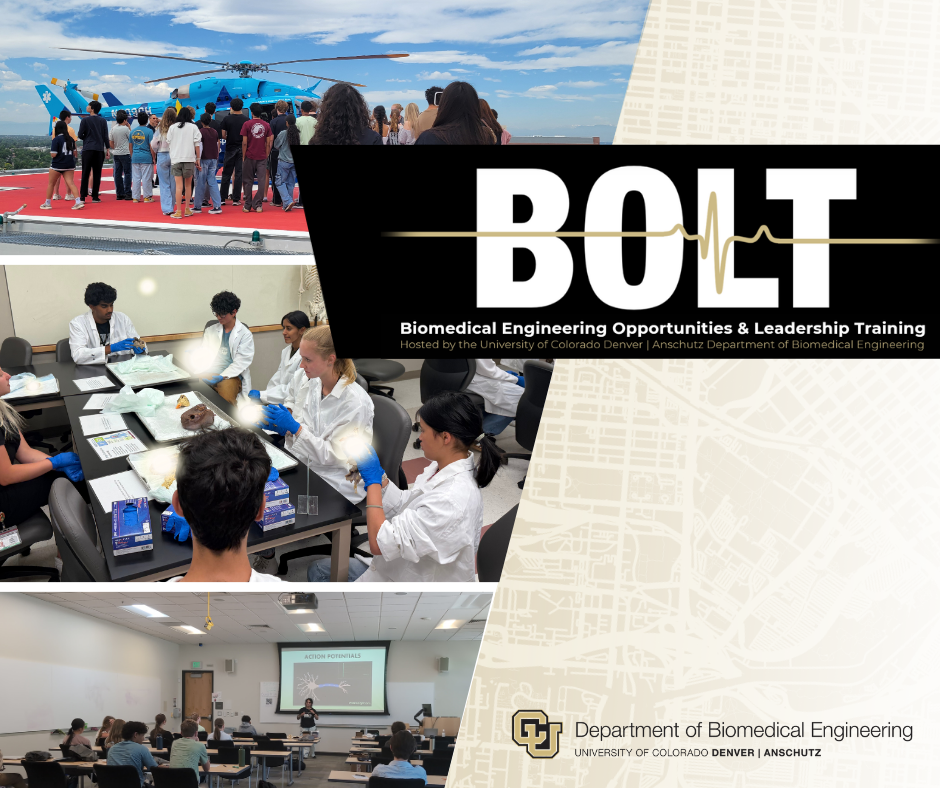
Before they ever apply to college, hundreds of Colorado high school students are getting an inside look at what it means to be an engineer at the University of Colorado Denver.
Each summer, CU Denver’s College of Engineering, Design and Computing welcomes aspiring innovators to its Biomedical Engineering Opportunities and Leadership Training (BOLT) Summer Program. Over four days, students build medical device prototypes, tackle engineering design challenges, tour research laboratories at the CU Anschutz Medical Campus, connect with faculty and student mentors, and meet professionals advancing the future of healthcare.
For Lexi Roth and Andrei Nicoara, BOLT became the launchpad for their engineering journeys. After participating as high school students, both Roth and Nicoara returned as teaching assistants, mentoring the next generation of campers and helping new students experience the same excitement they felt discovering their passion.
This fall, Roth will begin studying biomedical engineering at CU Denver. Nicoara recently completed his first year studying chemical engineering at CU Boulder. Although they chose different academic paths, both credit BOLT with helping them discover where they fit within the broad world of biomedical innovation.
More than a summer camp
BOLT immerses students in the same collaborative, research-driven environment that defines CU Denver’s biomedical engineering program.
For Roth, the experience answered a question she’d been asking for years.
“The reason I took BOLT is because I wanted a better understanding of what biomedical engineering is,” Roth said. “Both of my parents are software engineers, so I understood what they do, but I didn’t really know what biomedical engineering looked like. I was interested in medicine, and I thought BOLT would be a great way to explore that.”
Nicoara arrived with a similar perspective.
“My dad is also a software engineer, so I had some experience with coding,” he said. “Before BOLT, most of what I knew about biomedical engineering came from robotics. I expected prosthetics and robotics applications, but I learned there was so much more to the field, including biology, cellular engineering and research.”
The experience ultimately shaped Roth’s college decision.
“The program showed me how broad and multidisciplinary the field is. You’re not locked into one area—you get exposure to so many different disciplines,” she said. “Because of that experience, I’m studying biomedical engineering at CU Denver this fall.”
Learning Like Engineers
Every BOLT participant takes on an intensive engineering design challenge modeled after the collaborative projects students complete throughout CU Denver’s biomedical engineering curriculum.
Working in teams, participants identify a problem, brainstorm solutions, build prototypes, test their ideas and present their work to judges. Along the way, they develop the same technical and professional skills that define successful engineers: communication, creativity, resilience and teamwork.
“Students receive a prompt, develop a solution, build a working prototype and then present their project,” Roth said. “It’s one of the most impactful parts of the program because students realize they really can solve complex problems.”
As campers, Roth’s team designed a laparoscopic camera defogger, while Nicoara’s group created a voice-activated door.
“We explored several different approaches,” Nicoara said. “There was a lot of trial and error, but that process taught us there are many different ways to solve a problem.”
For many students, the design challenge becomes the moment they start thinking of themselves as capable engineers.
“One of my favorite things as a TA is watching students go from not knowing how to approach a challenge to creating something they’re genuinely proud of,” Roth said. “You can actually see their confidence grow throughout the week.”
Exploring Careers in Biomedical Innovation
BOLT extends beyond engineering projects by helping students envision the many careers their interests can lead to.
Career panels introduce participants to faculty, researchers and industry professionals whose experiences demonstrate there is no single pathway into biomedical innovation.
One conversation left a lasting impression on Nicoara.
“I remember hearing from Dr. Brisa Peña during a career panel,” he said. “She came from a chemical engineering background rather than biomedical engineering. That helped me realize there wasn’t just one route into the field.”
That insight influenced his decision to study chemical engineering while keeping his sights on healthcare and biomedical research.
For Roth, the panels broadened her understanding of the profession.
“The career panel was really helpful because it showed all the different paths into biomedical engineering in industry and academia,” she said. “It’s not just one path. There are so many different ways to get into biomedical engineering.”
Connecting With Research
Students also gain access to something few high school programs can offer: the opportunity to experience research at the CU Anschutz Medical Campus.
Laboratory tours introduce participants to faculty and graduate researchers developing new medical technologies, advancing imaging techniques and tackling complex healthcare challenges.
“The Gibson Biophotonics Lab was especially memorable,” Nicoara said. “Every time I’ve visited through BOLT, I’ve learned something new.”
That experience doesn’t end when camp concludes.
Through the BOLT Alumni Research Experience, former participants return to campus to tour additional laboratories, meet researchers and build relationships with professionals working at the forefront of biomedical innovation.
“One of the most valuable parts is the opportunity to build connections,” Nicoara said. “Students meet professionals working in research and leave with people they can reach out to if they have questions or want to explore future opportunities.”
Where Future Engineers Begin
Both Roth and Nicoara returned to BOLT as teaching assistants, mentoring new campers while strengthening their own leadership skills.
For Roth, helping students discover their confidence became one of the most rewarding parts of the experience. “Teaching other students helped me realize that I really enjoy teaching and mentoring,” Roth said. “Returning to BOLT really solidified my journey into biomedical engineering.”
For Nicoara, returning revealed how much he had grown.
“Projects that seemed intimidating when I was a student now feel much more approachable because I’ve gained experience with engineering concepts, coding and system design,” he said.
For Roth, that foundation led directly to CU Denver. For Nicoara, it opened the door to chemical engineering and biomedical research. For every student who walks through BOLT’s doors, the destination may be different, but the first step is the same: discovering what’s possible.
Every summer, BOLT invites students to see engineering not as an abstract career, but as a way to solve real-world problems, improve lives and make meaningful discoveries. By opening that door early, CU Denver is helping cultivate the next generation of biomedical engineers, researchers and innovators who will shape the future of healthcare in Colorado and beyond.
Leave a Reply